Affiliate Disclosure: This article contains affiliate links. If you book or purchase through these links, I Need My Vacation may earn a small commission at no extra cost to you. We only recommend services we genuinely trust and use ourselves to help you plan the perfect trip. Thank you for your support!
Miami-Dade County offers a limited complimentary post-cruise shuttle pilot from PortMiami to Miami International Airport (MIA) exclusively for Carnival Celebration and Icon of the Seas passengers on select 2026 dates. This one-way service operates after disembarkation and requires verifying specific sailing eligibility beforehand.
🚖 Secure Your PortMiami Airport Backup
The free shuttle operates on select dates only and lacks published luggage policies. Compare paid private transfers to guarantee a stress-free ride to MIA with all your bags.
💡 When the Kiwitaxi page opens: Set pickup to “PortMiami Cruise Terminal”, destination to “Miami International Airport (MIA)”, and input your exact disembarkation date and flight time.
🎯 Key Takeaways Before You Disembark
🚢 Carnival Celebration passengers are the named group for the new complimentary shuttle pilot, beginning in October 2026.
🌊 Icon of the Seas passengers have a continuing complimentary airport shuttle service on select dates.
➡️ The announced direction is PortMiami to MIA after disembarkation, not the airport-to-port journey before sailing.
📅 A ship’s scheduled return doesn’t automatically establish shuttle availability for that specific date.
🚐 A paid private transfer offers a reliable backup when the limited free shuttle doesn’t fit your flight schedule.
🚌 What Does the PortMiami Free Shuttle Pilot Actually Cover?
Miami-Dade County’s October 16, 2026 announcement described a Carnival Cruise Line pilot beginning that month. It offers complimentary transfers to MIA for Carnival Celebration passengers on select dates. The county also described the continuation of the existing Royal Caribbean Group Complimentary Airport Shuttle Program for Icon of the Seas passengers. These measures form part of cruise-season traffic planning at Miami-Dade County’s PortMiami. They do not establish a fleetwide airport-transfer benefit for all cruise lines.
The announced journey begins at the port after passengers disembark and ends at Miami International Airport (MIA). Your arrival in Miami before sailing remains a separate transport expense. Our guide to flying in before your cruise explains how a buffer night fits into that arrival plan. Keep both journeys separate in your budget; a complimentary ride homeward doesn’t cover getting to the ship.
🎟️ Who Qualifies for the Carnival and Royal Caribbean Airport Shuttles?
The practical starting point is your ship and return date, rather than the cruise-line logo on your booking. Carnival Celebration is the ship named in the Carnival pilot. Icon of the Seas is associated with the continuing Royal Caribbean service. The reported information doesn’t establish additional benefits based on cabin category, loyalty status, or how much you spent onboard.
Eligibility is tied strictly to the specific ship and sailing date, not general cruise line loyalty.
📅 Does every Carnival Celebration or Icon of the Seas sailing qualify?
The pilot operates on select dates. A Carnival Celebration or Icon of the Seas booking alone doesn’t establish that a complimentary airport ride is included for your specific sailing. A Miami cruise ship schedule lists vessel arrivals and departures, answering when a ship is expected in port, but not when this specific shuttle operates. Don’t count the same saving before it’s part of your confirmed travel arrangements.
🧳 How Do You Plan Your PortMiami Shuttle Ride and Luggage?
A free ride can save money, but a rushed airport connection can give that saving straight back. We’d build the day around your flight deadline first, then choose transport. The shuttle’s price is attractive, but timing, bags, and passenger needs still determine whether it’s actually useful for your group.
Shuttle luggage policies remain unpublished, making private transfers a safer bet for heavy packers.
✅ What should you confirm before disembarkation day?
Keep your sailing-specific transport instructions together with your flight booking. A compact departure plan should match the transport date to the day you leave the ship, save any issued departure instructions offline, and keep passports, medication, and flight documents in your personal carry-on bag. The announcement doesn’t establish luggage handling or accessibility arrangements.
⚠️ Hidden Trap Warning: Your airport journey starts before the vehicle moves. Leaving the ship, collecting baggage, and completing terminal formalities all take time. A ship’s arrival time is the beginning of the disembarkation process, not your airport departure time. A free transfer doesn’t remove MIA check-in queues or guarantee that an early morning flight is workable.
Factor in Miami traffic and MIA security lines when planning your post-cruise flight departure.
⚖️ How Do Free Shuttles Compare to Paid PortMiami Transfers?
The complimentary shuttle has one clear advantage: eligible passengers don’t pay for the announced ride. A taxi or private transfer adds cost, but may fit your group or departure plans better. The best value is the ride that accommodates everyone, fits your luggage, and aligns with your airport plan.
Private sedans offer door-to-door service and flight tracking, unlike shared shuttle schedules.
Transport Option
Cost Basis
Main Consideration
Complimentary Shuttle
Free for eligible passengers
Limited program availability & dates
Taxi
Metered applicable fare
Vehicle space and physical availability
App-Based Ride (Uber/Lyft)
Quote at booking (surge pricing)
Demand, wait times, and vehicle category
Private Pre-Booked Transfer
Locked quoted booking price
Guaranteed space, flight tracking, & terms
🚐 When is a pre-booked private transfer the better backup?
A pre-booked ride suits travelers with extra luggage, child-seat needs, mobility requirements, or no included shuttle arrangement. The quoted total matters more than a low headline price. Pre-book your fixed-price airport transfers with 🚖 Kiwitaxi or 🚐 GetTransfer so your driver is waiting regardless of terminal crowds.
🧳 Glide Through the Terminal: Premium Hard-Shell Luggage
TUMI V3 Large Expandable 4-Wheeled Packing Case (~$895)
Navigating a busy PortMiami terminal and securing your luggage on a crowded shuttle requires gear that won’t fail you. The TUMI V3 Large Packing Case is crafted from a lightweight, multi-layer polycarbonate alloy, features an integrated TSA-approved lock, and includes TUMI Tracer® recovery technology. Its dual-wheel system glides effortlessly through cruise terminals and airport concourses.
💡 When Amazon opens: Copy/paste “TUMI V3 Large Expandable Packing Case” to ensure you get the checked-luggage size with the expandable zipper for cruise souvenirs.
❓ People Also Ask: PortMiami Shuttle FAQ
1. Does PortMiami offer free shuttles to Miami International Airport?
Yes, but only on a limited basis. A complimentary pilot was announced for Carnival Celebration passengers, alongside a continuing Icon of the Seas service. Both operate on select dates after the cruise. This isn’t a general airport shuttle available to every PortMiami passenger.
2. Which cruise ships qualify for the free PortMiami airport transfer?
Carnival Celebration and Icon of the Seas are the two ships identified in the reported program information. Their inclusion doesn’t establish availability for every return date. Other Carnival and Royal Caribbean ships are not included in the announced scope.
3. Can I take the free shuttle from MIA to PortMiami before my cruise?
No. There is no inbound airport-to-port service established by this pilot. The announced direction is strictly PortMiami to MIA after disembarkation. Your pre-cruise airport ride, hotel transfer, and terminal journey remain separate parts of the vacation budget.
4. Are luggage rules and shuttle pickup locations published?
The available announcement doesn’t establish baggage limits, baggage handling, or an exact pickup point. General taxi and rideshare staging information doesn’t supply those specific shuttle instructions. Keep essential documents and medication in your personal carry-on throughout the journey.
☕
Support the Blog
If you love our travel guides and vacation tips, consider buying us a coffee to fuel the next adventure!
The Carnival Celebration pilot and continuing Icon of the Seas service offer a useful saving on selected post-cruise dates. However, their limited scope matters more than the word “free.” We’d keep the shuttle in the plan when it’s explicitly included in your sailing arrangements and fits your flight schedule. A paid backup makes sense when it doesn’t.
🚖 Finalize Your PortMiami Logistics
Compare flexible pre-cruise hotels, lock in your private airport transfers, and secure your travel insurance today.
Affiliate Disclosure: This article contains affiliate links. If you book or purchase through these links, I Need My Vacation may earn a small commission at no extra cost to you. We only recommend services we genuinely trust and use ourselves to help you plan the perfect trip. Thank you for your support!
When an airline changes your flight schedule, compare the new itinerary with your original before accepting it. Under U.S. DOT rules, significant changes like a 3-hour domestic or 6-hour international delay, airport swaps, or added connections qualify you for a full cash refund if you decline the alternative.
🔍 Need a Backup Flight or Compensation?
Compare alternative flights before requesting a refund, or check if your disrupted European flight qualifies for up to €600 in cash compensation.
💡 When the flight page opens: Enter your original origin and destination, select your travel dates, and toggle “Flexible dates” to find the closest alternative to your disrupted schedule.
🎯 Key Takeaways Before You Click Accept
💾 Save the original itinerary and the change notice before making any decisions or clicking accept.
🔍 Compare arrival dates, airports, connections, and cabin class, not only the new departure time.
🗣️ Ask for an airline-arranged alternative before paying for a replacement ticket yourself.
📂 Separate your flight refund, prepaid vacation costs, and compensation claims. Different rules apply to each.
Open the original confirmation beside the revised itinerary. Compare every flight segment, including the return journey, as airlines can adjust more than one leg in the same notification. Flight schedules normally show local times; an overnight departure or arrival can shift your hotel dates, even when the time difference looks small. Look closely at airport codes. JFK and EWR serve the same general destination, but switching between them drastically changes your ground transportation. A different connection airport can also introduce new immigration, transit-document, or overnight-stay requirements.
💺 Did your cabin or paid seats change?
An aircraft swap can move your seats without changing your flight times. Review the cabin class, paid seat assignments, baggage allowance, and any special assistance attached to the booking. For families, the immediate concern is keeping children seated with an accompanying adult. For premium-cabin travelers, compare the cabin actually assigned with the one you purchased. Save receipts for seats and other extras. If the replacement flight doesn’t provide a paid service, include that unused service in your refund request rather than assuming it follows automatically.
🔄 Will the New Connection Still Work for Your Trip?
🎫 Are both flights on one ticket?
A connection on one through-ticket usually provides stronger disruption protection than separately ticketed flights. Two flights displayed together on a booking website aren’t proof of a protected connection. Ask for an itinerary that meets the airport’s applicable minimum connection time, then consider your actual journey: terminal changes, border processing, mobility needs, and traveling with children. A technically valid connection can still be a highly stressful choice. We’d favor more breathing room when the next flight is the final departure of the day.
🧳 Are you making a self-transfer?
Separate tickets leave you with more responsibility. You may need to collect luggage, clear immigration, change terminals, and meet another airline’s bag-drop deadline. If the first airline moves your flight, the second airline doesn’t automatically owe you a replacement; its no-show and change rules can still apply. The same problem affects cruise departures. Our guide to arriving before your Caribbean cruise explains why a buffer night can protect a much larger vacation investment. Treat a newly shortened self-transfer as a priority, even if the airline calls its timetable adjustment “minor.”
🇺🇸 When Does a Schedule Change Qualify for a U.S. Refund?
For flights to, from, or within the United States, the Department of Transportation’s refund rules define significant changes. You must explicitly decline the changed transportation to pursue the qualifying unused-ticket refund. Accepting and taking an alternative generally means you can’t also receive a cash refund for that transportation.
Change to the Itinerary
Domestic Itinerary
International Itinerary
Departure moved earlier
At least 3 hours
At least 6 hours
Arrival moved later
At least 3 hours
At least 6 hours
Different origin/destination airport
Qualifies
Qualifies
Added connections or cabin downgrade
Qualifies
Qualifies
⚠️ Hidden Trap Warning: Refunds go back to the original payment method within 7 business days for credit cards. A travel voucher may be useful, but it isn’t the same as money returned to your bank. Don’t select a voucher by habit when a qualifying cash refund better fits your plans.
🇪🇺 What Rights Apply to Flights Covered by EU261?
🗺️ Does your route qualify for European protection?
The EU air passenger rights guidance generally covers departures from EU airports on any airline, as well as arrivals from outside the EU on an EU operating carrier. The guidance also covers Iceland, Norway, and Switzerland. A U.S.-based traveler can qualify because coverage follows the route and operating airline, rather than nationality. For a covered cancellation, passengers have a choice of reimbursement, rerouting at the earliest opportunity, or later travel.
💶 Could you receive cash compensation too?
A refund and compensation serve different purposes. Eligible EU cancellation claims can bring fixed compensation of €250, €400, or €600, depending on distance and the route. Notice matters: cancellation notice at least 14 days before departure generally rules out fixed compensation. Shorter notice doesn’t guarantee payment either, as replacement-flight timings and extraordinary circumstances (like severe weather) can affect eligibility. Keep the notification date and replacement itinerary, as those details matter more than the inconvenience alone. You can submit a claim directly to the airline, or use a service like Compensair to handle the paperwork on a no-win, no-fee basis.
🗣️ How Do You Ask the Airline for a Better Flight?
Start with a clear request. Have the booking reference, original schedule, revised schedule, and one or two workable alternatives ready. Use the airline’s official app, website, or the contact details in your booking confirmation. If an agency issued the ticket, start with that seller when the booking directs changes through it.
✅ Quick Win: Use this exact script when messaging the airline:
“My flight was changed by the airline. The revised arrival no longer works for my trip. Please move me to [Alternative Flight Number/Date] and handle it as an involuntary schedule change without additional fare or change fees.”
Once agreed, request the updated ticket confirmation. A conversation about available seats isn’t the same as a completed rebooking. Keep everyone traveling together on the request; moving one person first can leave the rest of the family without seats on that flight. Finally, address paid seats, baggage, and assistance, as a replacement ticket solves the route but those details can still need manual attention.
⚖️ Should You Take the Refund or Keep Traveling?
The refund can look attractive until you price the replacement. During school holidays or a busy weekend, new airfare may cost far more than the original booking. Compare the entire recovery cost: replacement flights, baggage, seats, extra accommodation, airport transportation, and any vacation time you would lose. If the airline offers a workable replacement without an extra fare, that may protect your budget better than canceling and starting again. If the new flight misses the purpose of the trip entirely, a refund may make more sense. A beach vacation can absorb a later arrival more easily than a strict cruise embarkation.
A qualifying refund returns the unused airfare. It doesn’t automatically buy you an equivalent replacement ticket at today’s prices.
🏨 How Do You Protect Your Hotels, Transfers, and Tours?
Handle the booking with the nearest penalty deadline first—that may be your hotel, rather than the flight. Send the property your revised arrival date and request written instructions for a late arrival. If you miss the first night without notice, the reservation’s no-show terms can put the remaining stay at risk. Our explanation of Caribbean resort cancellation policies covers an expensive distinction: changing a reservation and canceling it can carry vastly different penalties. Next, update airport pickups, rental-car collection, and timed activities. A transfer booked for the old airport won’t solve a new arrival somewhere else.
Airports are incredibly noisy, especially during widespread schedule changes and delays. The Sony WH-1000XM5 features industry-leading noise cancellation, 30-hour battery life, and multipoint connection. Block out the chaotic terminal announcements so you can focus entirely on making rebooking calls and managing your itinerary in peace.
✅ Industry-Leading ANC✅ 30-Hour Battery Life✅ Multipoint Bluetooth
💡 When the page opens: Enter your new arrival airport and terminal, input your revised flight number, and select “Meet & Greet” so your driver tracks delays automatically.
📂 What Should You Save for Travel Insurance or a Dispute?
Create one digital folder containing the original itinerary, change notice, revised tickets, supplier messages, and itemized receipts. Save the exact date and time you received the notification. Record the airline’s stated reason for the change, as insurance benefits can depend on the cause, length of disruption, and type of expense. Existing travel insurance or credit-card coverage may help with eligible costs, but a timetable adjustment alone doesn’t establish coverage, and buying insurance after learning about the change generally won’t protect that known event. Read our Caribbean travel insurance guide to separate cancellation, interruption, delay, and missed-connection benefits.
💡 Pro Tip: For expensive replacement transport, contact your insurer’s assistance team before committing when practical. Ask about authorization requirements and keep their written response. If an eligible refund remains unresolved, send a formal written complaint to the airline or the DOT’s Office of Aviation Consumer Protection.
❓ People Also Ask: Airline Schedule Changes FAQ
1. Can I get a cash refund for a small airline schedule change?
A small time adjustment (e.g., 45 minutes) doesn’t automatically meet U.S. DOT significant-change thresholds. However, other changes can qualify regardless of time, including a different origin or destination airport, added connections, or a cabin downgrade. Airline policies may also offer additional flexibility beyond the legal minimum.
2. Does Basic Economy remove my schedule-change refund rights?
No. An eligible airline-initiated change is entirely different from voluntarily changing a restricted ticket. For U.S.-covered travel, Basic Economy does not remove your right to a qualifying cash refund when you decline the significantly changed transportation offered by the airline.
3. Will the airline pay for my lost hotel night due to a schedule change?
An airfare refund doesn’t automatically include a separately booked hotel. Hotel terms, applicable passenger-rights rules, airline commitments, package protections, and existing travel insurance dictate your recovery options. Keep the hotel invoice, the no-show penalty proof, and the airline’s change notice together for your claim.
4. Can I choose a cash refund instead of rerouting in Europe?
Yes, for a covered EU261 cancellation. The EU cancellation and reimbursement FAQ explains the choice between full reimbursement and rerouting. Be aware that choosing reimbursement ends the airline’s obligation to provide the alternative journey you declined, so ensure you can secure your own replacement flights first.
☕
Support the Blog
If you love our travel guides and vacation tips, consider buying us a coffee to fuel the next adventure!
🛡️ Keep the Schedule Change From Becoming a Bigger Bill
An airline schedule change needs a decision, but accepting the first replacement isn’t always the cheapest answer. Protect the whole vacation before choosing between rebooking and a refund. Save the notice, request a workable flight, and update the ground bookings affected by your new arrival. If a covered European cancellation also supports a compensation claim, paid assistance is optional but highly effective for complex disputes.
✈️ Finalize Your Recovery Plan
Compare backup flights, check your EU261 compensation eligibility, and secure travel insurance for future disruptions.
💡 When the compensation page opens: Enter your original flight number and date. The system will automatically verify if your delay or cancellation meets the €600 EU261 threshold.
Affiliate Disclosure: This article contains affiliate links. If you book or purchase through these links, I Need My Vacation may earn a small commission at no extra cost to you. We only recommend services we genuinely trust and use ourselves to help you plan the perfect trip. Thank you for your support!
Caribbean beach safety requires swimming only in lifeguarded zones, understanding local warning flags, and identifying rip currents before entering the water. Always avoid swimming during double-red flag closures, hurricane season swells, or when sargassum seaweed and bacteria warnings are active.
🌴 Give Your Beach Trip a Backup Plan
Compare stays with pools and flexible rates, or book guided water activities matched to your comfort level. A booking never overrides a beach closure.
💡 When the hotel page opens: Type your destination, select your dates, and filter by “Free cancellation” and “Swimming pool” to ensure you have a safe backup if the ocean is rough.
🎯 Key Takeaways Before You Swim
🚩 Read the posted flag legend at local beaches; colors and meanings aren’t identical everywhere in the Caribbean.
👨🚒 Choose a swimming area watched by lifeguards, and keep children within close, touch-distance adult reach.
🌊 A smooth gap between breaking waves can hide a dangerous, fast-moving rip current.
🛟 If carried offshore, float and signal for help. Avoid fighting directly against the current to prevent exhaustion.
🦠 Keep open wounds out of seawater, and leave immediately when thunder, closures, or sargassum buildup interrupt your swim.
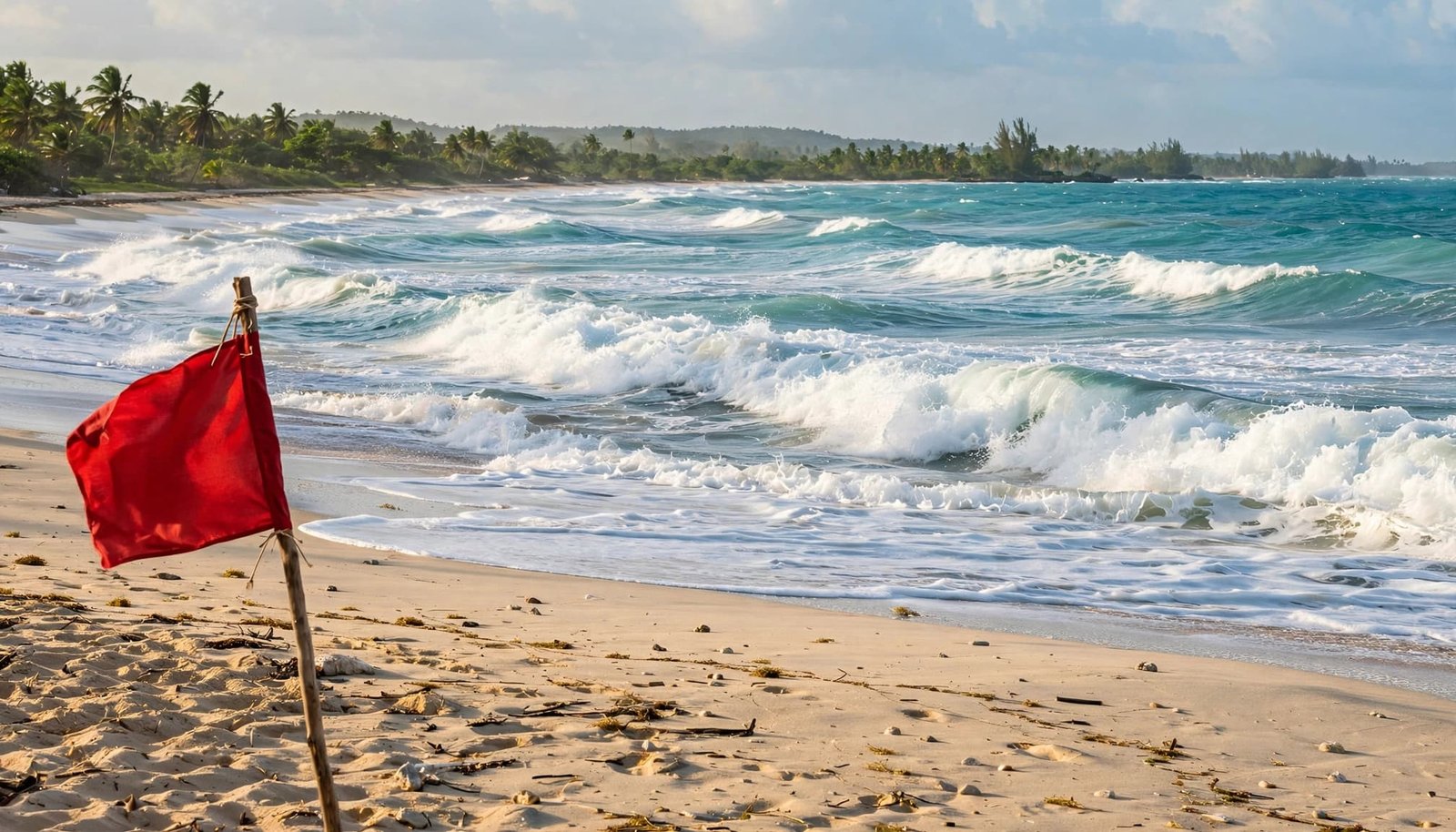
Beach flags are your first filter, but the local legend controls the meaning. Across the Caribbean, beaches use international-style symbols, simpler systems, or additional restrictions. A colored flag describes conditions or restrictions, but it doesn’t confirm that lifeguards are watching or that the water is safe. No flag means no information, not automatic permission. An empty flagpole, faded sign, or quiet stretch of sand offers no safety guarantee. If the forecast, flag, and visible conditions disagree, choose the more cautious decision. A sunny afternoon doesn’t cancel an offshore swell.
Flag or Marker
Common Meaning
Your Swimming Decision
Green
Lower hazard
Stay alert; currents remain possible.
Yellow
Moderate hazard
Use extra caution; weaker swimmers stay out.
Red
High hazard
Stay out without direct lifeguard guidance.
Double Red
Water closed
Do Not Enter
Purple
Dangerous marine life
Follow the posted restriction.
Red/Yellow Markers
Designated supervised area
Swim between them only while patrol is active.
Always check the local flag legend, as meanings can vary slightly between different Caribbean islands.
🌊 How Can You Spot a Rip Current?
Rip currents are narrow flows that carry water away from shore. In the Caribbean, the strongest can exceed 5 mph, faster than most swimmers can sustain. They move people offshore rather than pulling them underwater. Exhaustion and panic make swimming especially dangerous. Watch for warning signs such as a darker channel, a break in the line of breaking waves, or foam traveling seaward. A quieter-looking channel isn’t necessarily safe; waves may break less there because the water is deeper, while an outgoing current occupies the gap.
⚠️ Hidden Trap Warning: A smooth, flat gap between crashing waves is often the most dangerous part of the beach. It looks like the easiest place to swim, but it is usually the exact location of a fast-moving rip current pulling water back out to sea.
🆘 What should you do if a current carries you offshore?
Recognize an early warning sign: you’re swimming toward shore, but the beach keeps getting farther away. Stop spending energy on the same unsuccessful movement. Scripps oceanographer Falk Feddersen advises conserving energy and floating with the current, then returning once you’re clear of its active flow.
Control your breathing and float or tread water. Keep your mouth above water.
Raise one arm and call for help when you can do so without losing flotation.
Swim parallel to shore to leave the narrow current. Don’t force the attempt if you’re tiring.
Once free, swim toward shore at an angle away from the current.
If you can’t escape, keep floating and signaling rather than exhausting yourself.
🏖️ Which Beaches and Seasons Need Extra Caution?
Travel reporting has identified strong-current hazards at Condado in Puerto Rico, Maracas and Manzanilla in Trinidad and Tobago, and Rendezvous, Little Bay, and Carr’s Bay in Montserrat. Treat those names as reasons for caution, not a complete danger list. Atlantic hurricane season runs June 1 through November 30. During hurricane season, distant storms can send dangerous swell toward the Bahamas before local rain or wind arrives. Winter also brings powerful North Atlantic swells to exposed Caribbean shores. December sunshine doesn’t guarantee flat water.
👨🚒 Why Do Lifeguards Matter More Than Beachfront Luxury?
A beautiful resort frontage can sit beside an exposed shoreline. Towels, loungers, and a beach bar don’t confirm that lifeguards are on duty. Our practical rule is simple: choose an actively patrolled swimming area. Staffing shortages and limited patrol hours affect some Caribbean beaches. For families, assign one adult to watch the water without a phone or drink. Swap responsibility clearly. Solo travelers should avoid swimming alone. A busy beach isn’t a substitute for an attentive swimming buddy. And keep alcohol for after your final swim.
🦈 How Worried Should You Be About Sharks and Stingrays?
Sharks deserve sensible precautions, but shark attacks shouldn’t distract you from currents and drowning prevention. Only about 30 of more than 500 shark species have been associated with attacks on people. Avoid turbid water and shiny items that resemble fish scales. Stingray tours operate in Antigua, Turks and Caicos, and the Cayman Islands. In sandy shallows where stingrays may be present, shuffle your feet rather than taking heavy steps to avoid a defensive barb strike. A puncture needs prompt medical attention; don’t pull out a deeply embedded barb yourself.
🦠 What About Sargassum, Bacteria, and Water Quality?
🌿 When should you avoid sargassum seaweed?
Dense floating mats can obstruct swimming and hide hazards. Decaying piles can release irritating hydrogen sulfide gases, especially where seaweed accumulates heavily. Leave if the smell causes coughing, eye irritation, or breathing discomfort. Don’t let children play in decomposing piles. Also avoid swimming near storm drains, sewage outfalls, or discolored runoff after heavy rain.
🩸 Why do open wounds change the decision?
CDC guidance is direct: keep open wounds out of saltwater and brackish water. This includes recent tattoos, piercings, surgical wounds, and ordinary cuts. Vibrio vulnificus can cause severe wound infections and necrotizing fasciitis. Seek urgent care for spreading redness, severe pain, swelling, blisters, or fever after seawater exposure. Protect your trip with comprehensive travel medical insurance via VisitorsCoverage to cover emergency evacuations.
🚁 Scout Beach Safety & Rip Currents from Above
DJI Mavic 3 Pro Fly More Combo (~$2,199)
Spotting rip currents, sargassum buildup, and jellyfish from the shoreline is incredibly difficult. The DJI Mavic 3 Pro features a triple-camera system with a 4/3 CMOS Hasselblad lens and 43-minute max flight time, allowing you to safely scout beach conditions, find secluded coves, and capture stunning aerial footage of your Caribbean vacation from a bird’s-eye view.
💡 When Amazon opens: Copy/paste “DJI Mavic 3 Pro Fly More Combo” to ensure you get the package with extra batteries and the premium controller.
🎒 What Should You Book and Pack for Safer Beach Days?
A cheap room loses value when every usable swimming spot requires another taxi. Match your accommodation to your comfort in the water and access to beaches. Prioritize a pool backup, straightforward beach access, and flexible cancellation terms. For snorkeling, use our Caribbean shore-snorkeling guide to plan entry points, exits, and buddy arrangements. Never stand on coral. Our first-time Caribbean island guide helps balance beach priorities with transport and activities. Pack a whistle, sun protection, drinking water, and a waterproof pouch for valuables.
✅ Quick Win: Weak swimmers need properly fitted, activity-appropriate approved flotation, not inflatable toys. Water shoes protect against sharp coral but don’t prevent rip currents.
❓ People Also Ask: Caribbean Beach Safety FAQ
1. Is it safe to swim in the Caribbean Sea?
Yes, swimming is suitable at beaches when conditions, supervision, and your ability line up. Choose designated lifeguarded areas and obey closures. Sheltered water can be more comfortable, but no beach offers permanently safe ocean conditions.
2. Does a green flag mean children can swim alone?
No. Green commonly indicates lower hazard, not a guarantee of safety. Children still need attentive adult supervision while swimming. Keep young children and inexperienced swimmers within close reach, and leave when conditions worsen or patrol ends.
3. Should beginners book guided snorkeling tours?
A guided outing can help with equipment, site selection, and supervision. Choose an activity suitable for your ability. A guide can’t make rough water safe, and flotation doesn’t remove the need for an exit plan and a swimming buddy.
4. Does travel insurance cover swimming accidents?
Coverage depends on the policy and activity. Emergency treatment, evacuation, snorkeling, diving, and organized water sports may have different conditions or exclusions. Alcohol-related incidents and disregarding safety restrictions can also affect claims.
☕
Support the Blog
If you love our travel guides and vacation tips, consider buying us a coffee to fuel the next adventure!
For Caribbean beach safety, check local flags, swim near active lifeguards, and skip swimming when conditions aren’t safe. A pool afternoon costs less than turning a warning into an emergency. Protect your booking budget, but don’t treat insurance as permission to ignore warnings. If the ocean is rough, utilize your resort’s pool or book a guided inland excursion instead.
🛡️ Finalize Your Safety & Logistics
Compare flexible hotels with pool backups, secure your medical travel insurance, and book guided water activities.
✈️ Flying Before Your Caribbean Cruise: The 2026 Buffer-Night Guide & Hotel Picks
Yes, you should fly in at least one day before your Caribbean cruise. Flying in the day before departure protects you from flight delays, cancellations, and lost luggage. For international or winter travel, arriving two days early provides a safer buffer against missed embarkation.
Affiliate Disclosure: This article contains affiliate links. If you book or purchase through these links, I Need My Vacation may earn a small commission at no extra cost to you. We only recommend services we genuinely trust and use ourselves to help you plan the perfect trip. Thank you for your support!
🚢 Give Your Cruise a Buffer Night
Don’t let a same-day flight delay ruin your vacation. Compare an earlier flight and a refundable buffer-night hotel with cancellation terms that fit your plans.
A morning arrival looks comfortable on paper. Then a mechanical problem, missed connection, flight delay, or delayed baggage can eat into the hours you expected to have. Cruise Critic recommends arriving a day or two early to reduce the impact of flight disruption. It’s practical advice, not just a universal cruise-line requirement. Landing time isn’t terminal arrival time; you still need to get off the aircraft, collect bags, find transport, and reach the correct cruise terminal.
⚠️ Harsh Truth: Don’t assume the cruise ship will wait. A cruise has a published boarding deadline, and your airline’s schedule doesn’t change it. An early nonstop flight reduces complications, but it can’t remove cancellations. An overnight stay separates those two deadlines.
📅 How Many Days Early Should You Fly In Before a Caribbean Cruise?
One night is a sensible starting point for a straightforward domestic flight. Two nights give you more recovery time when the journey has several weak spots. Use your route to choose the buffer. Couples can turn the extra time into a relaxed dinner, while families may value a proper night’s sleep more than sightseeing. Budget travelers should price both arrival dates before assuming the shorter stay costs less.
🏨 2026 Buffer-Night Hotel Snapshot (from ~ per night):Hilton Miami Downtown (Near PortMiami) ~$220; Hyatt Regency Orlando (Port Canaveral shuttle) ~$190; The Westin Fort Lauderdale Beach (Port Everglades) ~$280.
🏨 Where Should You Stay Before Your Caribbean Cruise?
Choose a hotel based on your landing time and next morning’s transfer. In a port city, an airport hotel and a port-area hotel serve different arrival plans. A harbor view is lovely, but a reliable arrival plan matters more. An airport hotel can work well after a late flight, but confirm shuttle hours. A port-area hotel simplifies embarkation morning. For Port Canaveral sailings, remember that Orlando International (MCO) isn’t beside the port; decide whether you want the 45-minute transfer after landing or before boarding.
Should you pre-book your cruise terminal transfer?
Pre-booking is useful when you need child seats, wheelchair accommodation, or a pickup at a fixed time. Use your ship name and terminal, not only the port name. Miami’s PortMiami, Fort Lauderdale’s Port Everglades, and San Juan’s cruise terminals aren’t interchangeable. Our Caribbean airport transfer tips cover luggage capacity and delay policies. If your cruise departs from Cancun or the Riviera Maya, pre-book your ground transport with 🚐 OMyTransfers for seamless rides.
🚖 Secure Your Fixed-Price Port Transfers
Skip the chaotic taxi lines. Lock in a fixed-price private ride from your airport or buffer hotel directly to your cruise terminal.
💡 When the page opens: Type “Miami Airport to PortMiami” or “Orlando MCO to Port Canaveral” for a guaranteed fixed rate.
🛡️ Will Travel Insurance Cover a Missed Cruise Departure?
It may, but only when the cause, delay length, and expenses meet the policy’s conditions. Having insurance doesn’t automatically mean a missed departure is covered. Look for trip delay, missed connection, trip interruption, and emergency medical evacuation. Include eligible prepaid, nonrefundable flights, cruise costs, and hotels when calculating your insured trip cost. Buy before a weather problem becomes known or foreseeable. Our Caribbean cruise travel insurance guide explains the differences worth comparing.
A buffer night helps you reach the ship. Insurance may reimburse eligible losses afterward. You need to evaluate both separately.
🛡️ Check Coverage Before Disruption Starts
Review missed-connection limits, qualifying delays, and cruise eligibility before purchasing your policy.
💡 When the page opens: Enter your total prepaid trip cost and verify “Missed Connection” coverage limits.
🧳 What Should You Pack in Your Cruise Carry-On?
Your carry-on bag should cover the first day, even if checked luggage arrives late or gets lost. Keep passports, boarding passes, credit cards, prescription medication, and essential medical supplies accessible. Add your phone, charging cable, power bank, and a swimsuit. Our Caribbean packing list is a handy checklist for the wider trip. If you are flying into a major hub and navigating large terminals, investing in premium, highly maneuverable luggage is essential for a stress-free buffer day.
🧳 The Ultimate Pre-Cruise Carry-On Upgrade
TUMI 19 Degree Aluminum International Carry-On (~$1,295)
When your checked bags are at the mercy of the airline, your carry-on becomes your lifeline. The TUMI 19 Degree Aluminum Carry-On features a striking, dent-resistant aircraft-grade aluminum shell, a built-in USB port for charging during layovers, and TUMI Tracer® recovery technology. Its premium 4-wheel spinners glide effortlessly over airport terminals and hotel lobbies, keeping your passport, meds, and first-day cruise wear completely secure and accessible.
✅ Aircraft-Grade Aluminum✅ Integrated USB Port✅ TUMI Tracer® Program
💡 When Amazon opens: Copy/paste “TUMI 19 Degree Aluminum International Carry-On” to view the premium Silver and Graphite finishes.
📋 What Should You Check the Night Before Sailing?
This is a final verification, not the time to discover an expired passport. The State Department recommends a valid passport with at least six months of validity beyond your travel dates. Royal Caribbean specifies six months after the cruise ends and requires original documents. Finish online check-in by your line’s deadline, keep your boarding pass in the required format, and save your arrival appointment. Download the cruise line app, but keep a paper backup of important contact details.
How should you handle embarkation morning?
Have breakfast, check the cruise line app for official updates, and confirm online check-in is complete. Leave according to your boarding appointment and realistic traffic allowance. Hotel checkout time isn’t your terminal arrival appointment. Attach the correct luggage tags before handing bags to port staff. If a delay could make you miss the ship, contact the airline and cruise line’s Emergency Travel Team immediately. Don’t book a flight to the next island without the line confirming that joining there is permitted.
❓ People Also Ask: Pre-Cruise Flight FAQ
1. Can I fly in on the morning of my Caribbean cruise?
You can plan it, but the timing carries significant risk. An early nonstop flight still leaves you exposed to sudden cancellations, baggage delays, and terminal traffic. Travel experts strongly recommend arriving the previous day to ensure you don’t miss the ship’s strict boarding deadline.
2. Is a refundable pre-cruise hotel worth paying more for?
Yes, especially while flights or plans may change. Compare the premium with the amount you’d lose on a nonrefundable booking. A refundable rate gives you the flexibility to adjust your buffer night if your flight schedule shifts or if severe weather impacts your departure city.
3. Will travel insurance pay if my flight makes me miss the ship?
Possibly, but only if the cause, qualifying delay, and expenses meet the policy’s specific conditions. You must confirm “Missed Connection” and “Trip Delay” coverage limits before purchasing. Always keep itemized receipts and written cancellation notices to support your claim.
🌅 Give Your Cruise a Calmer Start
The extra hotel night buys you recovery time, a proper rest, and fewer decisions on embarkation morning. That’s worth comparing against the apparent savings of a same-day flight. Choose your arrival date first, then book a flight, hotel, and terminal transfer that work together. Before paying, compare the complete overnight cost and confirm the cancellation terms. Give your Caribbean vacation room to start well.
✈️ Ready to Secure Your Buffer Night?
Compare flexible flights, lock in your refundable port-adjacent hotel, and pre-book your terminal transfer today.
🧸 Caribbean Resort Kids Clubs 2026: Age Limits, Toddler Care & Best Family Programs
The best Caribbean resort kids clubs depend on your child’s age and toilet-training status. While luxury resorts like The Ocean Club and Rosewood Baha Mar offer complimentary clubs for ages 4-12, toddler care under 4 usually requires paid, specialized nurseries like Club Med’s Baby Club.
Affiliate Disclosure: This article contains affiliate links. If you book or purchase through these links, I Need My Vacation may earn a small commission at no extra cost to you. We only recommend services we genuinely trust and use ourselves to help you plan the perfect trip. Thank you for your support!
🏨 Compare Family Dates & Childcare Eligibility
Enter every child’s exact age. Compare room layouts, final prices, and flexible cancellation terms while you confirm kids club availability separately.
💡 When the search page opens: Enter your destination (e.g., “Nassau” or “Punta Cana”), add the exact ages of all children, and filter by “Kids Club” or “Family Rooms.”
🎯 Key Takeaways Before You Book
🏖️ The Ocean Club offers eligible guests complimentary access to its club for ages 4 to 12, but lunch costs extra.
🦜 Rosewood Explorers lists ages 4 to 12, while Baha Mar’s separate kids-club page lists ages 3 to 12.
👶 Club Med separates babies, toddlers, school-age children, and teens. Nursery services cost extra at participating resorts.
⚠️ A room reservation doesn’t automatically reserve childcare. Confirm sessions, diaper rules, and availability directly with the resort.
A kids club only gives you downtime if your child is actually allowed to stay. Caribbean resort kids clubs have vastly different age limits, schedules, and charges. You must check eligibility as you plan a family vacation, especially when traveling with toddlers, siblings in different age groups, or teens. I always start with the childcare rules, then compare rooms and prices. Our guide to family-friendly Caribbean resorts helps you compare destinations, but the granular details below matter before you commit your deposit.
👧 Which Caribbean Resort Kids Clubs Fit Your Child’s Age?
Start with eligibility. A beautiful playroom won’t help if your youngest is below the minimum age. These published details offer a shortlist, not a guaranteed childcare reservation. Always confirm ages, program names, costs, and schedules with the resort before booking. Also, check your child’s age on the actual travel dates, not when you make the reservation.
Resort / Program
Published Ages
Schedule & Vibe
Cost Detail
Rosewood Explorers (Baha Mar)
4 to 12
Split sessions; nature & marine focus
Complimentary
The Ocean Club (Four Seasons)
4 to 12
Arts, crafts, marine-habitat exploration
Club free; lunch extra
Baha Mar (General Program)
3 to 12
Confirm applicable program per hotel
Request pricing
Club Med (Caribbean)
4 mos to 17 yrs
Separated by strict age bands
Baby/Toddler clubs extra
✈️ 2026 Family Airfare Snapshot (round-trip economy, from ~): JetBlue JFK–NAS (Nassau) ~$320; American MIA–PUJ (Punta Cana) ~$280; Delta ATL–MBJ (Montego Bay) ~$350.
🏨 2026 Resort Snapshot (from ~ per night):The Ocean Club (Paradise Island) ~$1,200; Rosewood Baha Mar ~$950; Club Med Punta Cana ~$450 (All-Inclusive adult rate); Beaches Turks & Caicos ~$800.
🌴 What Makes a Camp-Style Kids Club Worth Choosing?
Does the schedule include real outdoor adventures?
When comparing kids club programming, ask about specific options such as nature walks, cooking classes, or adventure programs. “Outdoor activities” could just mean a short playground visit. A sample calendar of daily programming gives you a clearer picture than the club’s marketing photos. For a nature-focused shortlist, ask The Ritz-Carlton, Grand Cayman about Jean-Michel Cousteau’s Ambassadors of the Environment, or Kimpton Seafire about Camp Seafire. Confirm current ages, schedules, and fees before booking around them.
👶 Which Clubs Accept Toddlers and Children in Diapers?
Where should parents of under-fours start their search?
For toddler childcare, Club Med’s program bands include Baby Club Med (4 to 23 months) and Petit Club Med (2 to 3 years). Both are paid services offered only at participating resorts. Don’t assume they’re available at every Caribbean property or included in an all-inclusive stay. Ask about nap arrangements, feeding, bottles, and advance reservations. For more island-specific options, compare our Jamaica family resort guide and confirm the youngest accepted age directly.
⚠️ The Diaper Rule: Age eligibility and toilet-training requirements are separate questions. A club that accepts three-year-olds may still exclude children in pull-ups. Ask whether staff change diapers and what happens after an accident. Get the answer in writing before paying a deposit.
🏰 Which Bahamas Luxury Programs Offer Meaningful Activities?
For families comparing luxury resorts, Rosewood Explorers at Baha Mar combines treasure hunts, Bahamian culture, and marine life conservation. It includes a craft zone and pirate-ship play, giving children quieter creative time alongside active play. Meanwhile, The Ocean Club’s Kids For All Seasons is complimentary for ages 4-12, featuring arts, crafts, and marine-habitat exploration. Lunch is available for a fee, while snacks and juice are complimentary.
⏰ What Hours Do Caribbean Kids Clubs Actually Cover?
Will you need to collect children at lunch?
Many experience pages list childcare from 9 a.m. to noon and 1 p.m. to 4 p.m. daily. A midday collection can make a long off-property excursion impractical. Furthermore, don’t assume daytime club access covers dinner. Ask whether evening movies, children’s dinners, or private nanny services are available, and whether they have separate charges. A club closing at 4 p.m. won’t cover your 7 p.m. dinner reservation. Confirm evening childcare before booking a nonrefundable dining experience.
Always ask whether parents need to remain on the resort property during supervised sessions. That rule can severely affect your plans, even when the operating hours look generous.
💰 Are Complimentary Clubs Better Value Than All-Inclusive Clubs?
The better value depends entirely on what your family will actually use. Compare the whole-trip cost, including meals, childcare, activities, and room requirements. Club Med generally offers Mini Club + (ages 4-10) included, but Baby and Petit clubs cost extra. The Ocean Club includes its children’s club, but lunch carries a fee. Our guide to what all-inclusive resorts include helps separate standard inclusions from extras. I wouldn’t pay a resort premium for childcare you can only use twice.
Walking from your family suite to the kids club or the main dining hall at a massive Caribbean resort is exhausting with a toddler. The UPPAbaby Vista V3 features advanced all-wheel suspension and puncture-proof tires that glide effortlessly over resort cobblestones, brick pathways, and beach boardwalks. It includes a massive storage basket for resort towels and souvenirs, and converts to accommodate up to three children as your family grows.
💡 When Amazon opens: Copy/paste “UPPAbaby Vista V3 Stroller” to compare colors like Greyson, Anthony, or Declan.
🎮 What Keeps Tweens and Teens Happy?
A teen lounge and a supervised children’s club offer vastly different experiences. Club Med offers teen programs in separate age groups (11-13 and 14-17). Beaches Turks & Caicos is another incredible option, featuring its Shadow Lounge, water park, and sports. Look beyond gaming: snorkeling, sailing, paddleboarding, and beach volleyball give older children real choices. Let your teen help choose the resort’s activity mix to prevent an expensive week of boredom.
🛡️ What Should You Ask About Supervision and Water Safety?
A water park isn’t a kids club. Pool access doesn’t automatically include someone responsible for supervising your child. Ask about staff-to-child ratios, first-aid coverage, sign-in procedures, and who is authorized to collect your child. Find out who oversees swimming, whether lifeguards are present, and how non-swimmers participate. Tell the resort about allergies, medication, and mobility requirements. Beach conditions also matter outside club hours; sheltered bays in Antigua, parts of Turks and Caicos, and Barbados’ west coast are useful starting points for young families.
📋 How Do You Book Without Paying for the Wrong Resort?
I always settle childcare eligibility before committing to a nonrefundable room. For Christmas, spring break, and major school holidays, start comparing around 8 to 12 months ahead. Family suites and guaranteed connecting rooms may limit your options before standard rooms do. “Free cancellation” needs a closer look—read the deadline and deposit conditions. If your family vacation starts in Cancun or the Riviera Maya before hitting the Caribbean islands, pre-book your airport rides with 🚐 OMyTransfers for seamless ground transport. Protect your entire family trip investment with comprehensive 🛡️ travel protection via EKTA to cover medical emergencies and trip interruptions.
🏨 Compare Family Room Prices & Secure Your Dates
Compare identical dates, occupancy, bed arrangements, and meal plans. Choose a flexible rate where available while you confirm club eligibility.
💡 When the page opens: Enter your exact destination, add the precise ages of all children, and filter by “Family Rooms” or “Kids Club.”
❓ People Also Ask: Caribbean Kids Clubs FAQ
1. Which Caribbean resort kids clubs are completely complimentary?
The Ocean Club’s Kids For All Seasons is complimentary for guests ages 4 to 12, although lunch costs extra. Rosewood Explorers at Baha Mar is also complimentary for hotel guests. Club Med includes school-age and teen programs in its general all-inclusive model, but baby and toddler clubs cost extra.
2. Which resorts offer childcare for children under four?
Start by checking participating Club Med resorts offering Baby Club Med (4-23 months) or Petit Club Med (2-3 years). These are paid services, and availability varies by property. Baha Mar’s general program accepts ages 3+, but you must ask about diapers, naps, feeding, and reservations before booking your room.
3. Do I need to reserve kids-club sessions before arrival?
Yes, you should ask the resort directly. Club access and session capacity are different things. If childcare is important to your daily plans, request a confirmed reservation and its cancellation conditions rather than relying on first-come, first-served availability after check-in, especially during peak school holidays.
🌅 Choose the Club Around Your Family’s Real Schedule
The right beachfront resort gives your children activities they’ll enjoy and gives you usable downtime when the kids club fits your schedule. Age eligibility, collection times, and total charges matter much more than a beautiful playroom photo when planning your resort vacation. Confirm those details first, then choose the room, beach, and meal plan that make the rest of your week easy.
🌴 Find a Resort That Fits Your Whole Family
Compare your exact dates and guest ages. Choose a flexible rate where available while you confirm club eligibility and sessions directly with the property.
🌴 Caribbean Resort Day Passes 2026: Costs, Cruise Timing & Best Options
A Caribbean resort day pass grants access to pools, beaches, and amenities without an overnight stay, typically costing between $55 and $159. Before booking, verify if food, drinks, and transportation are included, and always plan your return around your cruise ship’s all-aboard time.
Affiliate Disclosure: This article contains affiliate links. If you book or purchase through these links, I Need My Vacation may earn a small commission at no extra cost to you. We only recommend services we genuinely trust and use ourselves to help you plan the perfect trip. Thank you for your support!
🍹 Ready to Book Your Resort Day Pass?
Compare your port-day options, verify inclusions, and secure your private transfer back to the cruise terminal before the ship departs.
💡 When the activity page opens: Type your port (e.g., “St. Maarten” or “St. Kitts”) and filter by “Day Trips” or “Resort Pass.”
🎯 Key Takeaways Before Booking a Day Pass
💰 Compare the final group total, including transportation, taxes, meals, and any balance payable at the resort.
🍔 Check whether your pass includes food and drinks, a spending credit, or facilities only. A $30 credit isn’t “free money” if you wouldn’t have spent it.
🔞 Confirm adults-only access in writing. An adults-only pool doesn’t necessarily make the whole resort adults-only.
🚢 Save the cancellation terms and return transportation details before paying, especially when visiting from a cruise ship.
🍹 What Do Caribbean Resort Day Passes Actually Include?
A day pass lets you access selected resort amenities without booking an overnight stay. What’s included depends on the specific product you buy, not everything shown on the hotel’s main website. The tourism board’s St. Maarten day-pass planning tips highlight that offers can include vastly different combinations of food, drinks, rooms, cabanas, and services.
Is it just pool access or a full all-inclusive day?
A basic pool pass may include loungers and towels, while lunch, cocktails, and beach equipment remain extra. An all-inclusive resort’s overnight dining package doesn’t automatically apply to day visitors. Check restaurant names, serving hours, drink restrictions, and whether premium menu items cost extra. A food-and-beverage credit is simply a spending allowance; once it’s used, you pay the difference out of pocket.
💰 How Much Will Your Resort Day Actually Cost?
The most useful number is what your group spends on the entire visit. Use this formula: Total day cost = admission + transportation + taxes/service charges + excluded food & drinks. Keep refundable holds separate; they affect available funds on your credit card but aren’t a final expense. Start by pricing the return ride, lunch, and shade. Those can change the value more than a small difference in admission. Our Caribbean vacation budget guide helps put these extras beside your wider trip spending.
🏨 2026 Resort Day Pass Snapshot (from ~): The Morgan (SXM) ~$60; Oyster Bay Day Room (SXM) ~$150; Park Hyatt (SKB) ~$100-$125; Sonesta Maho All-Inclusive (SXM) ~$119-$159.
🏝️ Which St. Maarten Resort Day Passes Are Worth Comparing?
St. Maarten has several distinct options: pool access, a private day room, food-credit offers, and all-inclusive access. Match the offer type before comparing prices. These published prices are date-sensitive starting points in U.S. dollars. Our St. Maarten neighborhood comparison can help you judge location before choosing a resort.
Resort / Offer
Published Price
Included Value
Main Check
The Morgan Resort
$60 / person
Infinity pool, Jacuzzi, loungers
Meals/drinks extra
Oyster Bay Beach Resort
$150 (up to 2)
Private day room, beach/pool
Great for couples
Seaview Beach Hotel
$55 (Weekends)
$30 F&B credit included
Weekend eligibility
Sonesta Maho Beach
$119 – $159
All-inclusive resort access
Verify live pricing
🏖️ What Should You Check for St. Kitts Resort Passes?
Park Hyatt St. Kitts is a luxury resort option for travelers seeking an upscale setting. Published listings show passes for $100 in low season and $125 in high season. The pass details describe beach access, two pools, and loungers. Seating is first-come, first-served. One listing includes a 10% discount on food and non-alcoholic beverages—that’s a discount, not an included lunch. Park Hyatt has an adults-only pool alongside a family-friendly pool, which can suit couples, but it doesn’t make the whole resort adults-only. I’d choose the closer, simpler option when it gives you more usable beach time. A luxury upgrade loses value when transportation takes too much of the day.
🚢 Will You Get Back to the Cruise Ship on Time?
Travelers can visit resorts independently while cruising, but they need a realistic port-day schedule. Start with the ship’s all-aboard time, then work backward. The resort’s closing time has nothing to do with your deadline. Allow for disembarkation, walking out of the terminal, transportation, and resort check-in. Check whether your ship uses local time or ship time. Our independent Caribbean shore-excursion guide covers the wider planning trade-offs.
⚠️ Missed Port Warning: A resort may refund an unused pass after a missed port, while the independent transfer provider keeps its payment. Check both cancellation policies separately before booking.
🚖 Price the Ride Before Buying Admission
Get the pickup location, driver contact, fare, and return time in writing. Confirm whether the fare is per vehicle or per passenger.
Resort day passes with “facilities only” mean you’ll be paying $18 for a basic cocktail or beer. The YETI Tundra Haul features durable rotomolded construction, NeverFlat wheels that glide effortlessly over sand and boardwalks, and premium pressure-injected insulation that keeps ice frozen for days under the hot Caribbean sun. Perfect for beach days where outside coolers are permitted or for your villa patio.
💡 When Amazon opens: Copy/paste “YETI Tundra Haul Portable Wheeled Cooler” to compare colors like Navy, White, or Charcoal.
🌧️ What Cancellation and Weather Rules Matter?
Read the policy before booking, including the deadline and its time zone. Ask what happens if your ship skips the port, arrives late, or changes its itinerary. Ordinary rain is another issue; a resort staying open during showers doesn’t necessarily owe you a refund. Check what happens if a pool or beach area closes. I’d pay a little more for useful flexibility when the alternative puts the whole day’s budget at risk. If you are booking a complex, multi-island cruise itinerary, consider comprehensive 🛡️ travel protection with EKTA to cover missed port excursions and trip interruptions.
❓ People Also Ask: Caribbean Day Pass FAQ
1. Are Caribbean resort day passes available to cruise passengers?
Yes, many resorts and specialist platforms sell passes specifically for cruise visitors. Check eligibility, access hours, transportation, and the ship’s all-aboard time. Admission usually doesn’t include cruise-terminal pickup unless the listing explicitly states so, so book your transfer separately.
2. Is an all-inclusive day pass better value than a basic pool pass?
It can be, provided you’ll eat, drink, and stay at the resort for most of the available day. Compare included restaurants and drinks with a facilities-only pass, then check the total against your budget. A short 3-hour port visit may not justify the $150+ all-inclusive upgrade.
3. Do day passes guarantee a lounger or umbrella?
Not always. Some offers provide access to first-come, first-served seating. Check the wording before booking. If shade is essential for your group, look for reserved seating, a cabana, or a private day room (like Oyster Bay), then confirm whether everyone in your group also needs general admission.
🌅 Book the Resort Day That Fits Your Schedule
The best-value pass is the one you can enjoy without surprise spending or a rushed return. Confirm the complete visit, including admission, meals, transportation, and cancellation terms. A clear plan leaves more room for the beach. If your island choice is set but your travel dates aren’t, compare flexible-date flights before paying a nonrefundable resort deposit. If your Caribbean adventure starts with a flight into Mexico before heading to the Riviera Maya for a resort day, pre-book your ground transport with 🚐 OMyTransfers for seamless Cancun rides.
🌴 Ready to Compare Alternatives?
Explore Caribbean day trips, verify inclusions, and compare them with your resort shortlist before booking.
🏰 Disney Caribbean Beach Resort Room Guide 2026: Best Buildings & Skyliner Access
The best room locations at Disney’s Caribbean Beach Resort for quiet nights and convenient access are Jamaica building 45 and Aruba building 51. These buildings offer a balanced walk to the Disney Skyliner and Old Port Royale, though specific room assignments are never guaranteed.
Affiliate Disclosure: This article contains affiliate links. If you book or purchase through these links, I Need My Vacation may earn a small commission at no extra cost to you. We only recommend services we genuinely trust and use ourselves to help you plan the perfect trip. Thank you for your support!
✈️ Planning an Orlando & Disney Escape?
Disney’s Caribbean Beach Resort is in Florida, not on a Caribbean island. Secure your flights to Orlando (MCO) and compare nearby off-site hotels or Disney packages before finalizing your village request.
💡 When the flight page opens: Enter your home airport + “MCO” (Orlando) and toggle “Flexible dates” to find the cheapest park days.
🎯 Key Takeaways: Pick the Walk You’ll Make Most
⚖️ Best balance: Request Jamaica building 45 or Aruba building 51 for reasonable access to Old Port Royale and the Skyliner.
💰 Best value question: A Preferred Room puts central amenities closer, but compare its 2026 full price with a Standard Room in the Barbados section.
🤫 Best quiet-night request: Ask for a room away from the main pool, bus stop, and busy walkway. A building number alone won’t settle the noise question.
👨👩👧 Best family caution: A fifth-sleeper booking or Little Mermaid room request doesn’t guarantee a particular theme, and the Trinidad section means longer walks.
♿ Best mobility precaution: Guest-room buildings have stairs and no elevators. Confirm a first-floor room and accessible features directly with Disney.
Your Caribbean resort room location at Disney’s Caribbean Beach Resort can shape whether mornings start with an easy walk or a long one. Disney’s Caribbean Beach Resort is in Florida, not on a Caribbean island. If you’re planning an actual island getaway instead, compare these family-friendly Caribbean resorts. If Disney is the plan, check the room category first, then decide which walk you want to make every day.
🗺️ Which Disney Caribbean Beach Village Should You Choose?
Start with your routine. Will you head to the Skyliner most mornings, refill drinks near Old Port Royale, or spend afternoons at the main pool? Caribbean Beach Resort wraps around Barefoot Bay, so a room that’s handy for one stop may be farther from another. Disney describes the layout as a spread-out moderate resort. The five commonly named areas are Jamaica, Aruba, Barbados, Martinique, and Trinidad.
Why do Jamaica 45 and Aruba 51 get recommended?
Buildings 45 and 51 sit near the bridge through Caribbean Cay toward Old Port Royale. They offer a practical middle ground between the resort’s central facilities and gondola access. The catch: request the building, not a guaranteed walking time. Building numbers can’t account for your assigned room’s exact position on the second floor or facing a busy pathway.
Village
Good Fit For
Main Trade-Off
Jamaica
Skyliner-focused stays (Bldg 45)
Farther from central dining
Aruba
Bldg 51 & Riviera access
Distance varies by building
Barbados
Frequent Old Port Royale visits
Central location costs more
Martinique
Main pool & dining convenience
Not ideal for Skyliner
Trinidad
Families seeking 5th sleepers
Longest walks to amenities
🤫 Which Buildings Deliver the Quietest Nights?
At Caribbean Beach Resort, I wouldn’t choose a room by village name alone if sleep is the priority. A room facing a busy walkway can feel different from one across the same building facing landscaping. Pool activity, bus stop traffic, and other guests returning late all matter.
Should couples choose a secluded room?
The Jamaica section or Aruba can work well for couples who want some separation from the main pool. Ask for “away from the pool and bus stop” rather than assuming a water view means privacy. A water-facing room can still look onto a path where people pass throughout the day. While a second-floor room may reduce footsteps outside your door, the stairs become part of every trip—a poor trade if you’re hauling a stroller.
A quiet village is a useful starting point. Your room’s position within the building is the request that can make a bigger difference at bedtime.
🚠 How Much Does the Disney Skyliner Change the Choice?
The Disney Skyliner makes room location more important at Caribbean Beach Resort than it was when every park morning started with a bus. Hollywood Studios and EPCOT days make Skyliner access appealing. The Jamaica section is a good place to investigate if you’ll use the main station often. Magic Kingdom and Animal Kingdom use bus transportation instead, so a Skyliner-friendly room won’t remove the walk to your bus stop.
📏 2026 Walking Distance Snapshot: From Jamaica’s quiet-pool area to the Skyliner station is approx. 0.21 miles (6 mins). From the same area to Old Port Royale is approx. 0.24 miles (6 mins). From Trinidad’s Spyglass Grill to Old Port Royale is approx. 0.45 miles (10+ mins).
💰 Are Preferred Rooms Worth Paying For in 2026?
A Preferred Room can make sense if your family expects repeated trips to Old Port Royale, Centertown Market, and the Fuentes del Morro Pool. But I wouldn’t pay for the category expecting the shortest route to the main Skyliner station. Preferred placement centers on resort convenience, not gondola access. Do the simple math: multiply the nightly difference (often $50-$80+ per night in 2026) by every night of your stay. Pay for a category you can book, not a building you can only request.
🏨 2026 Disney Caribbean Beach Rate Snapshot (from ~ per night):Standard Room ~$250; Water/Pool View ~$285; Preferred Room ~$330; Preferred Water View ~$380. (Prices vary heavily by season and park crowd calendars).
👨👩👧 What Should Families Know About Trinidad and Fifth-Sleepers?
Trinidad deserves a careful look if your family wants the Little Mermaid theming or needs a 5th-sleeper room (which includes a Murphy-style pull-down bed). However, it also deserves an honest look for its walking distance. A room that thrills a child at check-in can feel less convenient after a late park night.
Can you guarantee a Little Mermaid room?
In the Trinidad section, don’t count on a general room request to guarantee Little Mermaid rooms. Check the exact room category and sleeping capacity offered for your dates. If the theme is the absolute reason for the trip, ask Disney directly whether any bookable category guarantees it before you pay. Otherwise, book the 5th-sleeper layout you need and treat the theming as a bonus.
🏖️ How Easy Is Beach and Pool Access From Your Room?
Caribbean Beach Resort has sandy waterfront areas around Barefoot Bay. They’re good for a break, a stroll, or time outside without heading to a park. They’re not ocean beaches, and you shouldn’t plan on swimming in the lagoon. If you want quick access, ask for a room near a paved path to the waterfront. Deep sand can stop a wheelchair or stroller, even when the route to the beach is paved.
♿ What If You Need Step-Free or Accessible Access?
Settle this request before discussing a favorite building. At Caribbean Beach Resort, guest-room buildings have two floors and no elevators. Don’t assume you can take luggage, a stroller, or a mobility device upstairs without difficulty. If you’re avoiding stairs, ask Disney to confirm a suitable first-floor arrangement. For wheelchair use, “first floor” isn’t a complete answer; you may need an accessible room with a roll-in shower.
⚠️ Accessibility Warning: Never trade a necessary room feature (like a first-floor accessible bathroom) for a preferred village or water view. Get essential access details confirmed directly with Disney in writing before travel.
👶 Conquer the Disney Resort Walk: Premium All-Terrain Stroller
UPPAbaby Vista V3 All-Terrain Stroller (~$1,099)
Walking 0.45 miles from Trinidad to Old Port Royale with a tired toddler is exhausting. The UPPAbaby Vista V3 features advanced all-wheel suspension and puncture-proof tires that glide effortlessly over Disney’s brick pathways, cobblestones, and resort bridges. It includes a massive storage basket for park souvenirs and converts to accommodate up to three children as your family grows.
💡 When Amazon opens: Copy/paste “UPPAbaby Vista V3 Stroller” to compare colors like Greyson, Anthony, or Declan.
📝 How Do You Request a Building Without Losing Your Room Type?
Book the category that meets your non-negotiable needs first (occupancy, bed setup, accessibility). Then send a brief location preference through Disney’s available pre-arrival options. Name one priority and one acceptable backup. For example: “Jamaica building 45 if available; otherwise, a quiet room near the main Skyliner station.” Avoid asking for building 45, a water view, a particular floor, and the quietest room all at once. The more conditions you add, the harder they are to match.
🚗 Rent a Car for Disney Flexibility
Tired of waiting for Disney resort buses to Magic Kingdom or Animal Kingdom? Renting a car gives you total control over your park arrival times and dining reservations.
💡 When the page opens: Type “MCO Airport” and filter for “Minivan” or “SUV” to fit the whole family and stroller.
❓ People Also Ask: Disney Caribbean Beach Room FAQ
1. What is the best Caribbean resort room location for quiet nights and easy access?
At Disney’s Caribbean Beach Resort, Jamaica building 45 and Aruba building 51 are the most balanced requests. Ask for a room away from busy paths, pools, or bus stops if sleep matters most. Neither building nor a quiet position within it is guaranteed, so book a room category you’d still be happy to use.
2. Are Preferred Rooms close to everything at Caribbean Beach?
Preferred Rooms are aimed at convenient access to central resort amenities like Old Port Royale and the main pool. That doesn’t mean every Preferred Room is the best choice for Skyliner mornings. Compare the full upgrade cost with an available Standard Room in Jamaica or Aruba, then choose the location that matches your daily routine.
3. Does Disney’s Caribbean Beach Resort have elevators?
No. Its two-story guest-room buildings do not have elevators. If stairs are a problem, confirm a first-floor arrangement with Disney directly. Guests who need accessible bathrooms or particular room dimensions should confirm those details separately before booking.
🌅 Choose the Room You’ll Appreciate at Night
That first morning walk matters, but so does the return trip after a 14-hour park day. At Disney’s Caribbean Beach Resort, Jamaica 45 and Aruba 51 are sensible requests for balancing transportation and central amenities. Your booked room category is the sure thing; your building request is a preference. Compare the full stay cost, protect any essential access needs, and make one clear location request. That’s a better plan than paying extra for a view or building you may not receive.
🎢 Ready to Plan Your Orlando & Disney Trip?
Compare off-site Orlando hotels, secure your MCO flights, and book skip-the-line park tours before your travel dates sell out.
🧾 Caribbean Resort Fees 2026: Hidden Costs, Deposits & How to Compare
Caribbean resort fees are mandatory daily property charges that cover amenities like Wi-Fi, pool towels, and parking, adding $20 to $50+ per night to your base room rate. To avoid surprise bills, always compare the final checkout total, including taxes, service charges, and refundable security deposits.
Affiliate Disclosure: This article contains affiliate links. If you book or purchase through these links, I Need My Vacation may earn a small commission at no extra cost to you. We only recommend services we genuinely trust and use ourselves to help you plan the perfect trip. Thank you for your support!
🏨 Ready to Compare the Real Price?
Search the same dates, guest count, and room type to see the final checkout total. Open the price details before you decide which offer is actually cheaper.
This mandatory property charge is tied to staying at a resort. It might cover pool towels, parking, Wi-Fi, or other amenities. You usually can’t remove it by telling the front desk you won’t use the pool. That low nightly price can change quickly once you add five nights of fees, a room upgrade, and a deposit at check-in. I start with the checkout total, then check what I might still owe at the property.
Which resort charges are mandatory vs. optional?
Start with the room rate, then look for a nightly property charge, government taxes, and mandatory service charges. For covered U.S. lodging offers, the FTC’s hotel-fee rule guidance says mandatory fees must be included in the advertised total price. Room upgrades, daily housekeeping where it’s optional, and protection plans depend on what you select. A refundable security deposit is different again: it can tie up money temporarily without becoming part of the stay’s cost.
🇺🇸 How Do U.S. Resorts with “Caribbean” Names Charge Fees?
There’s one geographic detail worth clearing up first. Caribbean Resort & Villas is in Myrtle Beach, South Carolina. Disney’s Caribbean Beach Resort is in Florida. Neither is on a Caribbean island. Both are useful examples because travelers searching their names run into two very different pricing models.
What does the Myrtle Beach resort fee cover?
Caribbean Resort & Villas lists a $20 nightly charge, plus tax. Its published resort policies say it covers parking, pool towels, local calls, and maintenance. For five nights, the charge adds $100 before tax. Standard Rooms and One-Bedroom Suites receive one parking pass, while Two- to Four-Bedroom Condos receive two. If three households plan to arrive in separate cars, two included passes won’t solve the parking plan.
Does Disney’s Caribbean Beach Resort charge a resort fee?
Disney’s Caribbean Beach Resort doesn’t show a separate nightly resort fee. Instead, its pricing relies heavily on room category and travel dates. A “Preferred Room” is priced for convenience near central resort facilities and the Skyliner hub, while a “Standard View” room is less central. Compare the full stay totals to see what each quote includes, as school breaks and holidays can shift room rates substantially.
🏝️ What Do Actual Caribbean Island Resorts Charge in 2026?
An island resort may use familiar words, but its taxes, service charges, and payment rules belong to that destination. Don’t apply a U.S. mainland $20 fee to a stay in Jamaica, the Bahamas, or the Dominican Republic. If you’re budgeting an island trip, add flights and ground transportation too. The Caribbean vacation cost guide can help you put the hotel quote beside the rest of the trip.
🏨 2026 Caribbean Island Resort Fee Snapshot:Sandals Dunn’s River (Jamaica, All-Inclusive) ~$0 Resort Fee (Airport transfers extra); Secrets Cap Cana (DR, All-Inclusive) ~$0 Resort Fee; Grace Bay Club (Turks & Caicos, Luxury) ~10% Service Charge + 12% Gov Tax; Excellence Riviera Cancun (Mexico) ~$0 Resort Fee (Cabanas extra).
✈️ 2026 Airfare Snapshot (round-trip economy, from ~): JetBlue JFK–PUJ (Punta Cana) ~$320; American MIA–MBJ (Montego Bay) ~$380; Delta ATL–AUA (Aruba) ~$450; American CLT–NAS (Nassau) ~$310.
What does “all-inclusive” actually leave out?
Meals and standard drinks may be covered while premium dining, spa services, excursions, and airport transfers cost extra. Room service, gratuities, and minibar rules also vary. Check what an all-inclusive resort actually covers before assuming every service is paid for. The exact reservation matters more than the label on the resort.
🧹 How Do Housekeeping, Deposits, and Protection Plans Add Up?
The optional housekeeping fee varies by room size. These published charges are per day, not mandatory nightly resort fees. Two days of housekeeping in a Standard Room add $31.90. In a Four Bedroom, the same two days add $79.90. Decide how often you want service before treating it as a small extra.
Room Type (Myrtle Beach Example)
Daily Housekeeping Fee
Resort Security Deposit
Standard Room
$15.95
$100 Refundable Hold
One Bedroom
$24.95
$100 Refundable Hold
Two Bedroom
$29.95
$100 Refundable Hold
Four Bedroom
$39.95
$100 Refundable Hold
Is resort protection the same as travel insurance?
No. The resort lists “Worry Free Vacation” ($49.99) for accidental room damage, and a seasonal “Vacation Protection Plan” for trip interruptions. Don’t mistake accidental-damage protection for trip-cancellation coverage. They address different problems. If you’re booking a non-refundable Caribbean island package, review Caribbean travel insurance coverage to protect your flights and excursions.
TUMI Alpha 3 Short Trip Expandable Packing Case (~$895)
Resort housekeeping and laundry services can cost $30+ per day. The TUMI Alpha 3 Short Trip Packing Case features a built-in suiter compartment and compression panels that keep your linen resort wear and evening dresses completely wrinkle-free. Pack more, pay less for optional resort services, and glide through the lobby with premium multi-directional wheels.
💡 When Amazon opens: Copy/paste “TUMI Alpha 3 Short Trip Expandable Packing Case” to view the black ballistic nylon edition.
⚖️ How Do You Compare Two Resort Quotes Fairly?
Compare the same dates, guest counts, room types, and bedding configuration. Then check the total cost, what’s due later, and what you could lose if you cancel. Use the vacation budget calculator once you have the lodging details. Add transportation and meals so a bargain room doesn’t crowd out the rest of your vacation.
The useful number is the stay total you can verify, not the nightly price you saw first in search.
🛡️ Protect Your Non-Refundable Resort Deposits
A storm doesn’t automatically make a non-refundable booking refundable. Secure a comprehensive policy that covers flights, hotel deposits, and excursions.
💡 When the page opens: Enter your total prepaid trip cost and verify “Cancel For Any Reason” (CFAR) and “Hurricane/Weather” coverage limits.
❓ People Also Ask: Caribbean Resort Fees FAQ
1. Are Caribbean resort fees charged per night or per stay?
It depends on the property. U.S. properties like Caribbean Resort & Villas in Myrtle Beach list $20 plus tax per night. For actual Caribbean island resorts, fees are often structured as a one-time 10% service charge and 12% government tax applied to the total room rate. Always check whether the charge is nightly, per room, or a percentage before multiplying it across your stay.
2. Is a resort security deposit an extra fee?
No. A security deposit (often $100 to $500) is a refundable hold authorized on your credit card at check-in. It can affect your available card balance while the authorization is in place, so keep it separate from your advance deposit, which is an actual payment toward the booking.
3. Will a resort protection plan refund my flights?
Don’t assume it will. Resort-specific protection plans usually only cover room damage or hotel-level cancellations. They do not cover airline tickets or missed connections. Read the plan terms carefully and check airline terms or buy a separate comprehensive travel insurance policy for flight-related losses.
🌅 Book the Total, Not the Teaser Price
A room can look affordable until the nightly fee, taxes, and optional services appear. Compare the full stay total, then check when the advance deposit is due, whether any card hold is refundable, and the cancellation deadline. That way, the price you choose is much closer to the price you’ll live with on vacation. The pleasant surprise should be the trip, not a smaller-than-expected balance at checkout.
🏝️ Want One More Price Check?
Compare resort rooms and cancellation options, then match the final total against the same room and dates elsewhere. Don’t stop at the search-results price.
Caribbean currency is not one thing. The right money plan depends on your exact island, but most first-time visitors do best with a no-foreign-fee card, a small stack of clean US Dollar bills, and local cash for taxis, markets, tips, and smaller restaurants.
Affiliate Disclosure: This article contains affiliate links. If you book or purchase through these links, I Need My Vacation may earn a small commission at no extra cost to you. We only recommend services we genuinely trust and use ourselves to help you plan the perfect trip. Thank you for your support!
🌴 Price Your Island Stay Before You Go
Compare refundable Caribbean stays quoted in US dollars, then leave room in your budget for cash, transfers, tips, and local meals.
💡 When the hotel page opens: Type “Barbados” or “Saint Lucia” + your dates, then filter “Free cancellation.”
💡 When the deals page opens: Type “Barbados all-inclusive” or “Saint Lucia resort” and compare the total with taxes included.
🎯 Key Takeaways for First-Time Visitors
🗺️ Check the Caribbean currency for every island, not every trip. Saint Lucia and Barbados are close, but they don’t use the same money.
💱 The Eastern Caribbean dollar (XCD) is fixed at EC$2.70 to US$1. That makes quick mental math easier across the eight-island currency union.
💵 Bring clean small US bills. US$1, US$5, US$10, and US$20 bills are practical for tips and small purchases. Coins aren’t useful tips.
💳 Use cards for large purchases, not every purchase. Hotels and larger restaurants often take cards; beach vendors, drivers, and markets may prefer cash.
🧳 Don’t spend your final XCD on another island unless you know it uses XCD. A few leftover bills are fine; a thick wallet of unusable cash is not.
📍 Quick Links for Caribbean Currency and Travel Money
💵 What Is the Eastern Caribbean Dollar and Where Is It Used?
The Eastern Caribbean dollar, written as XCD or EC$, is the shared Caribbean currency of eight destinations. Together, they form an eight-member currency union. It is issued by the Eastern Caribbean Central Bank, rather than by a separate bank on each island. The Eastern Caribbean Central Bank’s currency page confirms that XCD is the official legal tender across its eight member countries. You may see prices written as EC$10, EC$50, or simply $50, so always ask which dollar a menu or taxi driver means.
Which islands use XCD?
Anguilla
Antigua and Barbuda
Dominica
Grenada
Montserrat
Saint Kitts and Nevis
Saint Lucia
Saint Vincent and the Grenadines
This is useful if you’re visiting more than one member destination. Because they belong to the same currency union, XCD may still work when you cross between these islands. The Caribbean looks connected on a map, but money changes quickly once you cross a border or board a ferry: Barbados has its own dollar, Jamaica uses Jamaican dollars, and Puerto Rico uses US dollars.
💱 What Is the Eastern Caribbean Dollar Exchange Rate?
The XCD/USD currency pair uses a fixed exchange rate of EC$2.70 for US$1. The Eastern Caribbean dollar has been pegged at that level since 1976, as historical data in this XCD exchange-rate history explains. This isn’t a floating currency pair you need to monitor every morning. The Central Bank supports the shared currency union, giving travelers a reliable rate to use. Shops may apply a slightly different rate when accepting US cash.
XCD Price
Rough US Dollar Value
Easy Way to Think About It
EC$10
US$3.70
A small snack or tip
EC$20
US$7.40
Casual lunch add-on
EC$50
US$18.52
Taxi or market purchase
EC$100
US$37.04
Tour deposit or dinner share
If a restaurant bill says “$80,” don’t assume it’s US$80. On many Eastern Caribbean islands, it may mean EC$80, or about US$29.63.
What bills and coins will you see?
Common XCD bank notes are EC$5, EC$10, EC$20, EC$50, and EC$100. Coins are used for smaller amounts, including EC$1. Don’t build your trip around coins: cashiers may return them as change, but travelers should prioritize small notes. Save coins for a final coffee, snack, or airport purchase. Divide the XCD price by 2.7 to estimate the US dollar amount, or multiply US dollars by 2.7 to find the EC value.
💵 Should You Bring US Dollars or Local Currency?
For most visitors, bring some US Dollar bills and plan to get local cash after arrival if needed. US bills are widely accepted in resort areas across many Caribbean destinations, especially for hotels, tourist restaurants, excursions, and taxis. Still, accepted does not always mean ideal: a vendor may quote you a less favorable rate, and you may receive change in XCD, Jamaican dollars, or another local currency.
When do US dollars make life easier?
Small, newer US bills are useful for tipping hotel staff, paying drivers, buying water, and covering a quick beach-chair rental. Keep bills crisp and avoid bringing only US$50 or US$100 notes. Resort guests often find US bills convenient because many big charges go on a card anyway, and families can use small bills for separate tip envelopes.
When is local cash the better choice?
Local currency is better for market stalls, roadside food, small local restaurants, and independent taxis. You are more likely to pay the posted price without doing mental conversion at every stop. In Saint Lucia, a member of the currency union, visitors may use small US bills at resorts, while local purchases are often priced in XCD. For couples and solo travelers who plan to leave the resort bubble, take out a modest amount of local cash early — don’t exchange a huge amount before you know your daily routine.
🎫 Reserve Excursions Before Cash Is Your Problem
Pre-booking a tour gives you the price upfront, then you only need small bills for tips, snacks, and extras on the day.
💡 When the page opens: Type “Saint Lucia catamaran” or “Barbados food tour” and filter by date and group size.
🌍 What Currencies Are Used Outside the XCD Zone?
Don’t assume Caribbean currency is shared across the entire region. The former British West Indies aren’t a modern single-currency zone, and each destination’s legal tender may differ. These popular destinations use different currencies, or operate outside that zone:
Destination
Main Currency
What First-Timers Should Know
Bahamas
Bahamian dollar (BSD)
US dollars commonly accepted
Antigua and Barbuda
Eastern Caribbean dollar
In the XCD currency union
Barbados
Barbadian dollar (BBD)
Not part of the XCD union
Jamaica
Jamaican dollar (JMD)
US dollars work in tourist areas
Dominican Republic
Dominican peso (DOP)
Resorts quote USD; locals use pesos
Puerto Rico & USVI
US Dollar (USD)
Easiest setup for US visitors
Martinique & Guadeloupe
Euro (EUR)
Bring a card and euro access, not XCD
✈️ 2026 Airfare Snapshot (round-trip economy, from ~): American MIA–SJU (San Juan, USD zone) ~$250; JetBlue JFK–UVF (Saint Lucia, XCD) ~$380; JetBlue JFK–ANU (Antigua, XCD) ~$400; American MIA–BGI (Barbados, BBD) ~$420.
🏨 2026 Stay Snapshot (USD per night, from ~):Condado Vanderbilt (San Juan, USD) ~$320; The Crane Resort (Barbados) ~$400; Sugar Beach, A Viceroy Resort (Saint Lucia) ~$900; Jade Mountain (Saint Lucia) ~$1,150.
Is Puerto Rico the easiest money choice?
For US travelers, yes. Puerto Rico uses the US dollar, and US citizens don’t need a passport when traveling from the mainland. That removes a lot of first-trip stress. If easy logistics matter most, see these best Caribbean islands for first-time visitors. Currency is one small detail, but it can make an island feel much easier.
What about Barbados and Jamaica?
Barbados and Jamaica are both easy to visit, but neither uses XCD. If your cruise or flight plan includes either island, don’t stock up on EC dollars. Use a card for bigger costs, then keep a small amount of that island’s currency for independent spending. That’s the safest middle ground.
💳 Can You Use Cards and ATMs in the Caribbean?
Yes, but don’t rely on cards alone. Major hotels, established restaurants, supermarkets, car-rental desks, and larger tour operators commonly accept cards. Cash is still part of normal travel life: small vendors, local taxis, beach bars, and market stalls may not accept cards, or their terminal may not be working that day.
Where do cards work best?
Use credit cards for hotel bills, resort dining, grocery runs, rental cars, and activities booked through an established operator. A card with no foreign transaction fee can save money over a full week. Tell your bank where you are going before departure — a declined card at a resort check-in is a bad start, especially after a long connection.
How much cash should you carry?
Carry enough for one day, not your whole vacation. Keep the rest locked in your room safe with your passport and backup card. For a practical setup, carry your primary card, a backup card stored separately, and small notes. The Caribbean packing list has more easy travel-wallet tips that prevent one lost wallet from ruining the trip.
📱 Keep Maps and Banking Apps Working
Install travel data before departure so you can check ATM locations, message drivers, and avoid expensive roaming charges after landing.
💡 When the page opens: Select “Saint Lucia” or “Barbados” (or the regional Caribbean plan) and install before you fly.
🧮 How Do You Avoid Bad Exchange Rates and Fees?
Airport exchange counters are convenient, but they can eat into your travel money budget through foreign exchange fees and spreads. If you need cash on arrival, take out only enough for the first day or two, then compare the exchange rate before choosing your next option. Use an ATM connected to a bank when possible, and compare its conversion with the mid-market rate. Your home bank, the local ATM owner, and your card issuer may each charge a fee.
Should you decline dynamic currency conversion?
If an ATM or card terminal asks whether you want to pay in US dollars, choose the local currency when your card issuer offers fair conversion terms. The card network’s conversion for the relevant currency pair may differ from the merchant’s offered conversion. Read the screen before tapping: the option with familiar dollars is not always the cheaper option.
Should you watch the change you receive?
A restaurant may accept US$20 for a small bill and return change in XCD. That is normal in the XCD zone, but understand what happened before you walk away. I treat foreign change as spending money for later that day: use it for lunch, snacks, or a taxi. Don’t wait until departure morning and hope a shop will take it.
🔐 How Do You Tip and Keep Cash Safe in the Caribbean?
Bring small bank notes for gratuities. Clean US$1, US$5, and US$10 notes are easy for staff to use; coins are not practical because they are hard to exchange. Some all-inclusive resorts include gratuities, while others do not — check the resort policy before you start handing out cash. For off-resort meals, drivers, and guides, local currency or small US bills both work better than a large note.
Should you buy XCD before you fly?
If you’re buying travel money before departure, availability may be limited outside the Caribbean. Compare the provider’s foreign exchange spread, fees, and any buy-back promise for leftover currency. For home delivery or click and collect, check the home delivery fee, arrival date, and collection deadline. For a short resort trip, I would not chase a large XCD order at home: bring small US bills, use a card, and withdraw local cash only if your plans call for it.
How do you keep cash safe without overthinking it?
Split your money between your day bag, hotel safe, and backup location. Never keep your passport, every card, and all your cash together. A waterproof pouch is helpful for boat days, beach bars, and sudden rain — it is a small item, but it can save a lot of stress. And the money you leave at home deserves protection too: store passports you won’t carry, backup cards, and spare cash in a fireproof, waterproof home safe while you island-hop.
Your smartest travel-money move happens before you fly: passports you won’t carry, backup cards, spare cash, and property documents stay home in a SentrySafe FW5020. It is ETL-verified fireproof for up to 1 hour, waterproof even when fully submerged, and big enough for documents, jewelry, and a backup wallet — so the cash you split across your day bag is never your only copy of anything important.
💡 When Amazon opens: Copy/paste “SentrySafe FW5020 fireproof waterproof safe” to compare the 0.9 cu ft and larger sizes.
🧭 What Is a Simple Money Plan for Island Hopping?
Island hopping creates more Caribbean currency decisions than staying on one island. Before each ferry, regional flight, or cruise stop, make a quick travel money check: confirm the currency, check what local currency is available, and decide whether you’ll need a card or ATM when you arrive. For the full spending picture, use this Caribbean vacation cost guide before you lock in flights and hotels.
What is a better plan for XCD island hops?
If your route stays inside the Eastern Caribbean dollar area, you can keep a small XCD float through the trip. That makes it easy to pay drivers, buy snacks, and cover quick local purchases. An itinerary within this currency union is simpler than one crossing into Barbados, Jamaica, Puerto Rico, or a French Caribbean island. If one of those destinations is next, spend down XCD first — your card becomes the best bridge between different currencies.
Should you plan airport transport before arrival?
Landing with no local cash is less stressful when your airport ride is already arranged. This is useful for late arrivals, families with tired kids, and travelers who don’t want to negotiate a taxi price after a flight. Pre-booking your airport ride keeps your first local expense clear and predictable, before you find an ATM or exchange cash.
🚗 Arrive With Your Transfer Sorted
Lock a fixed-price ride from the airport to your resort so your first island expense is known before you touch an ATM.
💡 When the page opens: Type “Hewanorra Airport (UVF) to Castries” or “BGI Airport to Crane Beach” for a fixed quote.
❓ People Also Ask: Caribbean Currency FAQ
1. What Caribbean currency should I bring for Saint Lucia?
Bring small US Dollar bills and use local cash for purchases outside the resort. Saint Lucia uses XCD at a fixed rate of EC$2.70 to US$1, maintained by the Eastern Caribbean Central Bank. Cards work at many hotels and restaurants, but cash helps with taxis, markets, and tips.
2. Can I use US dollars in the Eastern Caribbean?
Usually, yes, especially in tourist zones. US cash is widely accepted, but it isn’t the island’s legal tender: merchants may apply their own exchange rate, and change often comes back in XCD. Keep small bills for convenience, then use EC dollars when you want posted prices.
3. Do I need cash at an all-inclusive resort?
Yes, but not a huge amount. Even when food and drinks are included, cash helps with airport transfers, staff tips, off-site meals, local taxis, souvenirs, and excursions. Check the resort’s gratuity policy before your trip, since tipping practices vary.
💡 Your Money Plan Should Stay Simple
The best Caribbean currency and travel money plan is not carrying every bill you might need. It is carrying the right mix: a good card, small US notes, and a little local cash when your island and travel style call for it. Check the currency before every island stop, and know whether that “$50” is US$50 or EC$50. That one habit keeps your vacation budget where it belongs — on beach days and good meals instead of avoidable fees.
🌴 Lock In Your Island Stay Before You Fly
Book a refundable stay quoted in US dollars, then build your cash plan around the island’s real currency.
⛴️ Caribbean Island Hopping Without a Car: The 2026 Ferry & Flight Guide
Caribbean island hopping without renting a car is easiest when you choose islands linked by dependable ferries, short regional flights, and walkable harbor towns. The strongest 2026 routes are the Martinique-St. Lucia ferry corridor and the St. Maarten-Anguilla beach split.
Affiliate Disclosure: This article contains affiliate links. If you make a qualifying purchase through these links, I Need My Vacation may earn a small commission at no extra cost to you. We only recommend services we genuinely trust and use ourselves to help you plan the perfect trip.
🌴 Price-Check Your Island Hop Before Rooms Disappear
Check flights first, then choose refundable stays near the ferry terminal. That order protects your vacation budget and prevents missed connections.
🗺️ Why Does Caribbean Island Hopping Need the Right Island Pair?
The Caribbean is not one easy ferry network. Islands can look close on a map, then turn into a full travel day because of border checks, limited sailing days, or a flight connection through another island. Car-free island hopping works best along connected corridors, rather than between scattered islands. Start with transport before choosing a hotel. A beautiful hotel is less exciting when it is an hour from the port and your ferry leaves at 7:00 a.m.
For a seven-night vacation, two islands is the sweet spot. With 10 nights or more, three islands can work if the connections are confirmed before you pay for nonrefundable rooms. Independent trips also give you more control than a cruise. You can compare Caribbean vacation packages versus booking separately before deciding how much freedom is worth to you.
The cheapest room is not always the best deal. A cheaper hotel far from the harbor can create two expensive taxi rides and a stressful departure morning.
⛴️ Which Connected Corridors Work Best for Car-Free Travel?
Why does the French Antilles corridor win?
Guadeloupe, Dominica, Martinique, and Saint Lucia form a strong route for travelers who prefer ferries over a rental car. Scheduled, bookable public ferries serve select island pairs in this Eastern Caribbean corridor. FRS Express des Iles operates an international network in the region. The crossing to Saint Lucia is listed as a 1-hour-30-minute nonstop ride, but check the operator’s current timetable before booking any hotel. This route suits couples, solo travelers, and active travelers seeking beaches, Creole food, rainforest, and slower days.
Why is St. Maarten/St. Martin and Anguilla simpler?
This is the better choice if you want two islands, white sand beaches, and less luggage shuffling. St. Maarten/St. Martin offers two personalities in one place, while Anguilla adds quieter luxury. Visit Anguilla lists the public ferry fare at US$30 one way for travelers 12 and older. The crossing is short, but you still need to allow time for immigration, baggage, and transport at both ends. Read the St. Kitts and Nevis island comparison before treating neighboring islands as an effortless ferry hop.
✈️ 2026 Island-Hop Airfare Snapshot (from ~): JetBlue JFK–FDF (Martinique) ~$380; American MIA–SXM (St. Maarten) ~$320; interCaribbean SXM–AXA (Anguilla flight) ~$150 (or take the 20-min $85 RT ferry).
🏨 2026 Ferry-Port Hotel Snapshot (from ~ per night):Hotel Simon (Fort-de-France, Martinique) ~$160; Bayfront Hotel (Marigot, St. Martin) ~$180; Zemi Beach House (Anguilla, luxury) ~$650; Sugar Beach, A Viceroy Urban Resort (St. Lucia) ~$450.
🚢 Should You Choose a Ferry, Regional Flight, or Cruise?
Choose the option that protects your vacation time, not the one that only looks cheapest at first glance. A ferry often wins between Martinique and Saint Lucia. Choose inter-island flights when routes are indirect or schedules don’t align. For farther-south options such as Grenada, flying may be more practical than a long ferry journey.
Travel Method
Best For
Main Advantage
Main Drawback
Ferry
Short, direct corridors
Lower cost + ocean views
Weather & limited schedules
Regional Flight
Indirect routes
Saves a long travel day
Baggage fees & airport time
Cruise
Unpack-once travelers
One cabin, fewer bookings
Less freedom in each port
⚠️ Harsh truth: Regional airlines like interCaribbean Airways enforce strict baggage rules (often a 10-pound carry-on limit). Never book a ferry connection on the same day as an international flight home. Give yourself one overnight buffer for weather delays.
🏨 Where Should You Base Yourself Without a Car?
A car-free trip is easier when your hotel does some of the work. Caribbean islands with public transportation vary in coverage, so choose a property near the ferry terminal, restaurants, groceries, and one or two beaches. Use licensed taxis or hotel-arranged rides for airport arrivals and ferry transfers.
🚖 Pre-Book Your Harbor & Airport Transfers
Don’t haggle with taxis at the ferry dock with all your luggage. Lock in a fixed-price private ride to your hotel.
💡 When the page opens: Type “FDF ferry terminal to Hotel Simon” or “SXM airport to Marigot” for a guaranteed fixed rate.
🛂 How Do You Handle Customs, Passports, and Currency?
A ferry between two countries is an international border crossing, not a local water taxi. You may need to show your passport, complete arrival forms, state where you’re staying, and show an onward ticket. Saint Lucia encourages visitors to complete its online immigration form, while St. Kitts and Nevis requires its ED Form before arrival. Dominica requires a passport valid for six months after arrival.
🗺️ Book Shore Excursions & Rainforest Tours Early
Reserve tours after your ferry times are locked in, then leave room for weather changes and a beach day.
💡 When the page opens: Type “Dominica rainforest tour” or “St. Lucia catamaran” and filter by your exact date.
💰 How Do You Budget and Book a Car-Free Island Hop?
Your flight and hotel are only the beginning. Add airport transfers, ferry fares, departure taxes, baggage fees, port taxis, food during travel days, and a backup night if a connection is missed. Create a separate transport budget before selecting hotels. Use this Caribbean vacation cost guide to compare the full trip total, not the headline nightly rate.
🧳 The Ultimate Car-Free Island Hopper: Premium Carry-On
When you’re hauling your own bags on and off ferries, up gangways, and into small island taxis, soft duffels rip and heavy suitcases break your back. The Briggs & Riley Sympatico is ultralight, features a built-in garment folder to keep resort wear crisp, and comes with a lifetime warranty that even covers airline damage.
💡 When the page opens: Select “Martinique” or the regional “Caribbean” eSIM to cover multiple islands on one plan.
🗓️ What Do Two Easy Car-Free Itineraries Look Like?
The 7-Night French Caribbean Route (Ferry Dependent): Fly into Martinique, stay three nights, then take the ferry to Saint Lucia for four nights. Fly home from your arrival island if the airfare works. This is the low-stress choice for a first independent island hop.
The 5-to-7-Night St. Martin & Anguilla Split (Ferry Dependent): Stay two or three nights on St. Martin, then take the ferry to Anguilla for the rest. It’s the best pick for travelers who want white sand beaches, beach bars, and less transport friction.
❓ People Also Ask: Caribbean Island Hopping FAQ
1. What is the best Caribbean island for island hopping without a car?
Martinique is one of the best bases because it connects to Guadeloupe, Dominica, and Saint Lucia by ferry. St. Maarten/St. Martin is better for a short trip that includes Anguilla. Choose based on confirmed routes, not map distance.
2. Can you island-hop in the Caribbean without a cruise?
Yes. Ferry corridors and regional flights make independent trips possible, especially in the Eastern Caribbean. A Caribbean cruise simplifies luggage and transport, but offers less control over your hotel location and time ashore.
3. Are Caribbean ferries reliable?
They can be reliable, but schedules change with the season, weather, and maintenance. Confirm the operator’s latest schedule, allow extra time for weather, and never schedule an international flight home on the same day as a ferry crossing.
🌅 Make the Trip Easy Before Making It Big
The best car-free Caribbean trip isn’t the one with the most pins on the map. It’s the one with confirmed transport, a realistic budget, and enough free time to enjoy the islands. Book the route first. Then choose a walkable base near restaurants, beaches, and beach bars, with dinner plans that make the vacation feel worth it.
🏨 Lock In Your Island-Hop Base
Choose flexible stays close to your ferry terminal, then save the beach splurge for the nights that count.
 Skip to content