 Skip to content

Best Time to Book Last-Minute Flights 2026 (Price Patterns, Day-by-Day Checklist, and When to Stop Waiting)
Last-minute trips never start calmly. For me, it’s usually one of three moments: a wedding invite that lands late, a burnout week where I can’t stare at one more email, or a surprise stretch of time off that feels like a lifeline. That’s when the flight search begins, chasing last-minute deals, and the numbers on the screen can feel like they’re taunting me.
Here’s the hard truth about last-minute flights in 2026: airlines don’t price like they used to. Fares move faster, “empty seats” don’t automatically mean “cheap,” and waiting can cost real money. Still, I’ve learned there’s a way to play this with flexible travel without panic-buying at the worst moment.
In this guide, I’m sharing the real price patterns I see most often, a simple day-by-day checklist for the booking window of the final 30 days, and the rule I use to decide when to stop waiting and book.
Affiliate Disclosure: This article contains affiliate links to Booking.com, Trip.com, Expedia.com, aviasales.com, and Amazon. If you book or purchase through these links, I Need My Vacation may earn a small commission at no extra cost to you. We only recommend services we genuinely trust and use ourselves to help you plan the perfect trip. Thank you for your support!
The truth about last-minute flight prices in 2026 (and why the old myths don’t work)
Photo by Torsten Dettlaff
People still repeat the same old line: “Airlines will drop prices if the plane isn’t full.” I wish that were reliable. In 2026, it’s not. Airlines price for what they think you’ll pay, not for what they wish they could sell.
When I say “last-minute,” I mean inside 21 days of departure. That’s the zone where fares can jump overnight, sometimes even in the same day. Airlines now react quickly to demand signals: search volume, booking pace, seasonality, and how many seats are left in each fare bucket, especially for domestic flights and international flights. If a flight looks half-empty, it might still be priced high because the airline expects late-booking business travelers, event travelers, or people with no flexibility.
That’s why the “clear your cookies” myth doesn’t help much. The bigger drivers are inventory and demand, plus dynamic pricing that updates constantly. Recent coverage of Google Flights airfare insights (summarized in this report) backs up what I see in real searches: booking windows still matter, especially for domestic trips, and close-in booking usually costs more (Google Flights timing summary).
If you’re shopping last-minute, you’re not trying to find the mythical secret day when flights become cheap. You’re trying to avoid the moments when prices usually step up hard, and you’re trying to keep your options open long enough to catch a fair fare.
If you want a fast reality check, compare prices right now on Expedia.com and Trip.com, then decide your next move:
If you also want one place to bundle options quickly (flight plus hotel), I use this page for Last‑minute flight deals 2026 when I’m trying to move from “browsing” to “booking.”
The three price cliffs that hit fast, 21 days, 14 days, and 7 days
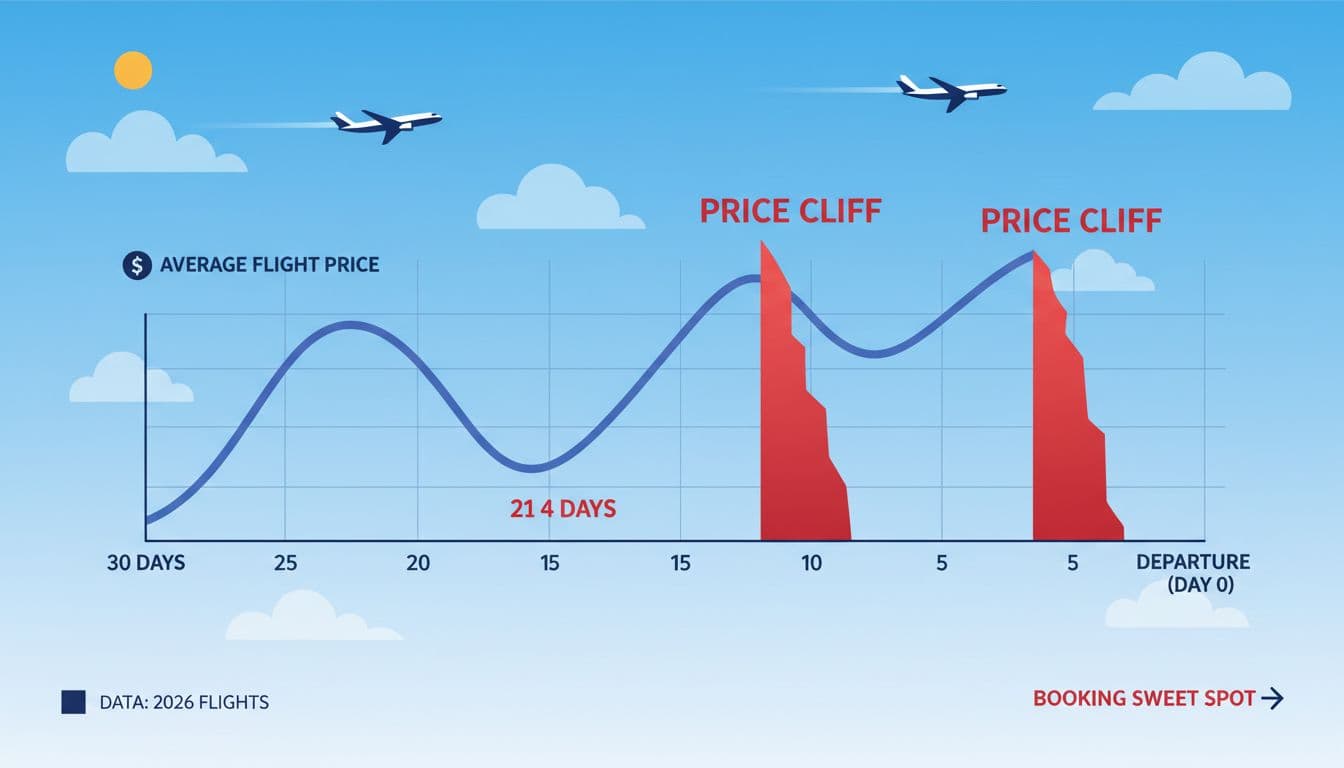
An at-a-glance timeline of the common 21-day, 14-day, and 7-day price cliffs (created with AI).
Over and over, I see the same pattern: the 21-day Goldilocks Window is safer than 14, and 14 is safer than 7. It’s not magic, it’s how airlines manage remaining seats. As the departure date gets close, cheap fare classes sell out, and what’s left is priced for urgency.
Here’s what I do at each cliff:
- At 21 days out: I decide if this trip is “must happen” or “nice if cheap,” then I set my max price.
- At 14 days out: I widen the search (nearby airports, one-stops) and I prepare to book quickly if I see a fair fare.
- At 7 days out: I stop expecting a deal, I focus on reducing damage (timing, fees, baggage, and total trip cost).
When last-minute deals still happen (and when they almost never do)
Deals can still happen, but they’re picky. Off-peak travel, less popular routes, and flights at odd hours have the best chance. On the other hand, peak travel weeks punish procrastination. Spring break, major holidays, and summer weekends are the classic traps where waiting often means paying more and flying worse.
I keep this mini checklist in my head:
- Waiting can pay off when: it’s an off-peak week, I can fly Tuesday or Wednesday, I’m open to a one-stop, and I have 2 or 3 alternate airports.
- Red flags that prices will jump: holiday weeks, big events in the destination, only a few nonstop flights per day, and tight seating (few options left at decent times).
If you need a season-by-season view of how far ahead people are booking in 2026, this breakdown is useful for context, even if you’re already inside the window (2026 booking timing guide).
Best time to book a last-minute flight: the simple timing rules I use
I don’t try to outsmart every price move. I follow a few timing rules that keep me calm and keep my wallet from taking the biggest hit.
First, the context: for many trips, “best time to book” isn’t last-minute at all. Data-based reporting keeps pointing back to a similar range: domestic flights often price best about 1 to 3 months out, and international flights often do better around 2 to 8 months out (with a common sweet spot around 3 to 5 months). Once I’m inside 21 days, the booking window is a gamble and I focus on controlling what I can.
The biggest lever is flexibility, particularly in shoulder season versus peak times. If I can adjust even one thing (departure day, nearby airport, time of day, one-stop vs nonstop), I usually find a better option than someone locked into Friday at 5:00 pm.
Also, I stay honest about day-of-week patterns. Midweek travel often costs less, and it’s been widely reported for 2026, but it’s not a law of nature. Sometimes the cheapest flight is the weird one at 6:10 am, and sometimes Sunday night drops because demand shifts. This overview is a helpful reminder that day-of-week savings exist, but they vary route to route (cheapest days to fly in 2026).
When I’m ready to move from “watching” to “winning,” I check hotel and flight bundles on Booking.com to lock the whole trip.
If I’m 30 to 21 days out, here’s the sweet spot that still gives me options
This is when I still have leverage. I can watch prices without feeling trapped.
What I do fast:
- Set 2 price alerts (one for my ideal flight, one for a “good enough” backup).
- Test alternative airports (even 60 to 90 minutes away can change fares).
- Compare one-stop vs nonstop because last-minute nonstop prices can turn ridiculous.
- Check a date grid for cheaper travel dates, then decide if shifting one day is worth it.
If I’m inside 14 days, my goal changes from “deal hunting” to “damage control”
Inside two weeks, I stop chasing perfection. I start protecting the trip. I widen airports, accept early departures, and I consider split tickets if it’s meaningfully cheaper (but only if layovers are safe and bags won’t be a mess).
This is also when I watch add-ons like a hawk. A “cheap” base fare can lose its charm fast once you add a carry-on, a checked bag, and seat selection. I compare total trip cost, not just the headline price.
My day-by-day checklist for the final 30 days (so I don’t panic-buy at the worst moment)

A simple countdown routine for the final month before departure (created with AI).
I like a plan that feels like brushing my teeth. Small, consistent checks beat one giant spiral at midnight when chasing last-minute deals. Here’s the routine I use, grouped by time windows so it stays doable.
- 30 to 22 days: Track prices daily with a price monitoring tool, but don’t obsess. Identify your top two itineraries, then set your budget ceiling.
- 21 to 15 days: This is the decision zone. Set flight alerts for your travel dates. If the fare is fair for your route and season, take it. If not, widen airports and flight times.
- 14 to 8 days: Reduce risk. Start prioritizing total cost (bags, seats, and change fees). Consider one-stops or one-way tickets.
- 7 to 3 days: Sprint mode. Short daily checks only. Grab “good enough” before options collapse.
- 48 hours to day of: I only wait this long if I truly don’t care where or when I fly, or I’m willing to cancel the trip.
Here’s the compact version I keep on one screen for flexible travel:
| Window | What I do | What I avoid | “Book now” trigger |
|---|---|---|---|
| 30 to 22 days | Price alerts, compare airports, set budget | Refreshing all day | Price is under my ceiling |
| 21 to 15 days | Narrow to 2 options, watch totals | Betting on a huge drop | Any “fair” fare appears |
| 14 to 8 days | Expand times, accept one-stop | Ignoring bag fees | Nonstop jumps, one-stop still fair |
| 7 to 3 days | 20-minute daily check | Panic-buying at night | Only bad times left |
| 48 hours to day of | Buy only if necessary | Hoping for empty-seat deals | Price rises twice in 24 hours |
When I’m in that final-month window, I compare side-by-side on Expedia.com and Trip.com, then I book the option that fits my ceiling.

The “7-day squeeze” feeling is real, which is why I rely on rules instead of vibes (created with AI).
The 21-day decision, the moment I either book, or I choose a different plan
At 21 days, I treat it like a fork in the road. If I’m still waiting, it’s a choice, not a habit.
My quick “if this, then that” rules:
- If it’s a must-attend trip, then I book when the fare is reasonable, not perfect.
- If prices are high and schedules are shrinking, then I switch airports or add a one-stop.
- If the destination is flexible, then I price-check a second city and compare total trip cost.
- If nothing looks good, then I shorten the trip by a day or shift to midweek.
The 7-day sprint, what I check every morning until I hit ‘purchase’
When I’m inside a week, I keep it simple and I keep it short. I check once in the morning, set a 20-minute timer, and stop when it rings.
My routine:
- Check a price calendar for cheaper day pairs.
- Check nearby airports (both ends).
- Check one-stop options with sane layovers.
- Confirm baggage and seat fees, then compare totals.
- Re-confirm my max price, and buy if it’s met.
The timer matters. It prevents the late-night doom scroll that leads to bad decisions.
When to stop waiting and book (even if it doesn’t feel perfect)
A “book now” moment, when the numbers finally match the plan (created with AI).
Waiting feels productive because it’s a decision you don’t have to make yet. But last-minute flight shopping has a hidden cost: once the good departure times disappear, you don’t just lose access to cheap airfare, you pay more and also lose comfort.
These are my “book now” triggers:
- Seats are clearly thinning (choices drop, prices rise).
- The fare hits my ceiling (including bags and seat selection).
- It’s a peak travel week (holiday travel, spring break, summer vacation).
- Only terrible flight times remain (overnights, brutal layovers).
- Hotel prices are rising too, and the whole trip is getting expensive.
- I’m traveling with kids or anyone who needs predictability.
- It’s an important event, and showing up matters more than saving $40.
Here’s the simple trade-off I remind myself of:
| Choice | Pros | Cons |
|---|---|---|
| Waiting | Chance of a small dip | Higher risk, fewer good round-trip flights |
| Booking today | Certainty, better schedules | Might miss a minor drop |
If you want more big-picture context on 2026 pricing trends, including how fares have been moving overall, this reporting is a useful reference point (when to book flights in 2026).
When my triggers hit, I lock it in on Booking.com or cross-check quickly on Expedia.com, then I stop shopping. If cash prices are too high, I check award space using points and miles from airline loyalty programs as a backup strategy.
The budget line rule, I pick my number, and I don’t second-guess it
I set one ceiling price for the whole ticket, not just the base fare. That means bags, seats, and any add-ons I know I’ll pay. If the fare comes in at or under that number, I buy and I move on. Peace of mind has value, and I treat it like part of the deal.
The peak date rule, if it’s a holiday week, I stop waiting sooner
Peak dates are ruthless because demand is baked in. For holiday weeks, I aim to book before 21 days when I can, and I rarely wait past 14 days. Inside two weeks on a peak route, the odds shift hard against you.
Conclusion
Mastering the Best Time to Book Last-Minute Flights 2026 doesn’t reward wishful thinking, it rewards timing and flexibility. I watch the three cliffs (21 days, 14 days, 7 days), I use a calm 30-day routine so I don’t panic-buy at midnight, and I follow clear “stop waiting” triggers when the trip matters.
If you’re close to departure, don’t aim for perfect. Aim for booked within the optimal booking window to snag last-minute deals. Lock in your trip now on Booking.com while you still have decent flight times and choices. Then cross-check quickly on Trip.com and Expedia.com to confirm you’re not missing a better routing. Finally, secure travel insurance to protect your high-cost last-minute booking.
FAQ
What’s considered a last-minute flight in 2026?
For my planning, “last-minute” means within 21 days of departure for domestic flights and international flights. That’s when price jumps become more common and good flight times disappear fast.
Is it cheaper to book flights at the last minute in 2026?
Sometimes, but it’s not the norm, especially during peak travel. Last-minute deals on domestic flights are most likely on off-peak routes with extra empty seats, not on holiday weeks or high-demand cities.
Should I book at 21 days out or wait longer?
If the price is within your budget and the schedule works, the 21-day mark is the Goldilocks Window to book. If you wait and hit 14 days, your options usually shrink and prices often rise.
What’s the best site to book last-minute cheap airfare for round-trip flights and hotels together?
When I want to lock the whole trip quickly, I start with Booking.com for trip planning and compare round-trip flight options across platforms. If you’re ready, book now.
What should I do if I’m booking within 7 days?
Switch from “deal hunting” to “damage control.” For flexible travel, expand airports, accept one-stops, set up flight alerts, and compare total costs with bags and seats included, then check options on Expedia.com.
Do flights get cheaper at midnight or on a specific weekday?
There’s no reliable “magic hour.” Midweek travel can be cheaper on many routes, but prices move based on demand and inventory, so check price history on Google Flights for your travel dates, set a budget ceiling for your travel dates, and book when it’s met.
© 2026 I Need My Vacation. All rights reserved.
